The four controls, and the failure each one prevents
The approach is organised around four controls because each corresponds to a way credential projects actually go wrong. They are applied in order, because a decision taken out of order usually has to be taken again.
- System
- Prevents producing a credential the installed locks will not accept — the most expensive failure and the most common.
- Construction
- Prevents a credential that is technically correct and physically wrong for the wear environment.
- Artwork
- Prevents a design approved flat that is illegible, misplaced or unreadable on the finished shape.
- Supply record
- Prevents a reorder that does not match, and a credential estate nobody can audit.
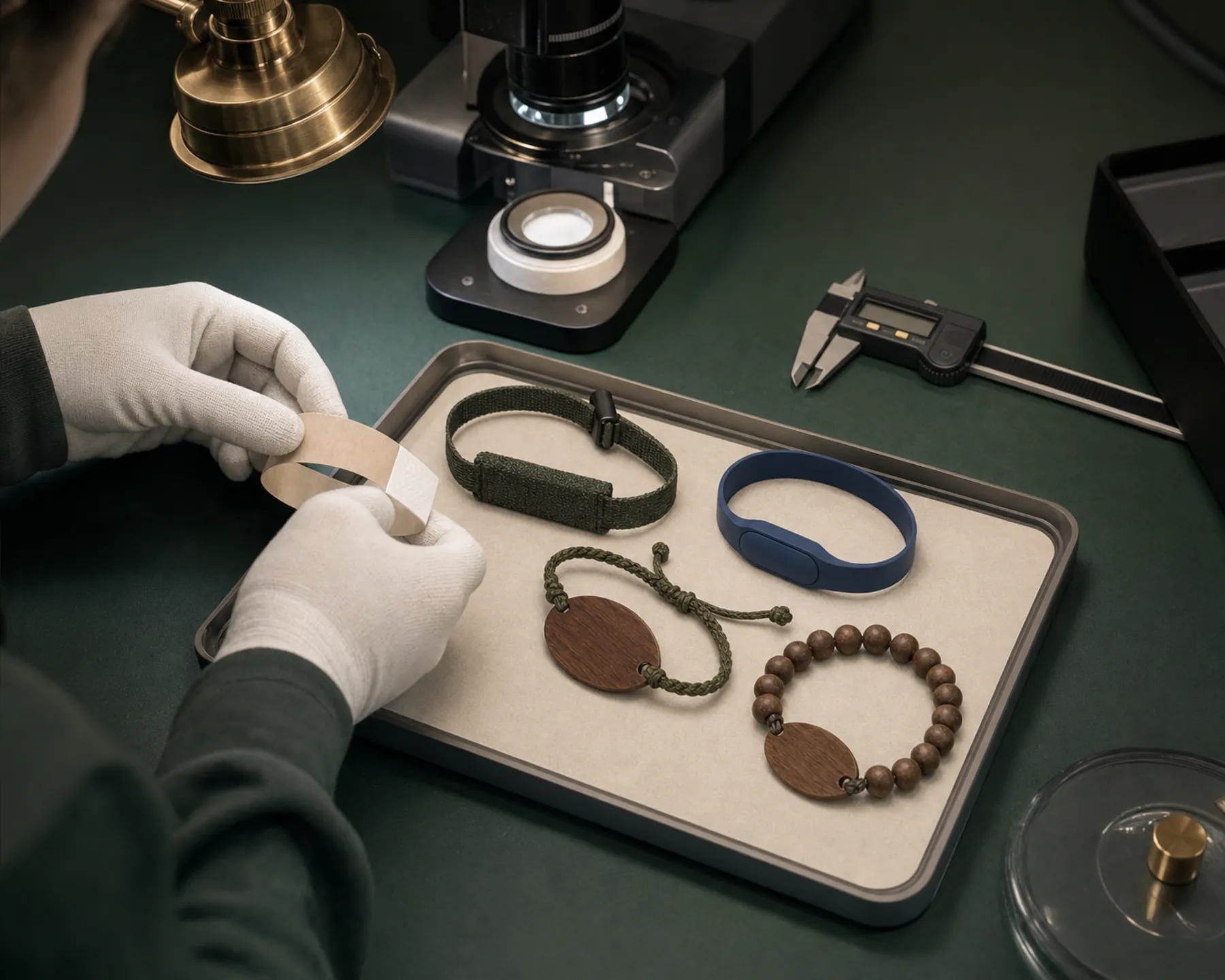
System first, because everything else depends on it
The credential technology and the encoding requirement are properties of the installation, not of the product range. Until they are established, every other decision is provisional — including which catalogue models are even available.
The fastest input is an existing credential that already opens doors. It carries the technology and often the numbering convention physically, which is why we ask for one rather than for a product name from a previous order.
Construction second, against the real environment
Wear period, moisture pattern, population, lifecycle and transfer risk narrow the range faster than any preference does. This is also where we rule things out: a wood face for a water park, a fabric band for daily immersion, a one-way closure for a property that intends to recover credentials.
Saying no at this stage costs a conversation. Saying it after a run costs the run.
Artwork third, on the production shape
A wristband curves in two directions, flexes at the closure and is read at an angle by someone not concentrating. Hairlines, small reversed type and tight registration all survive a flat proof and fail on the object.
Approving on a production-realistic sample removes that entire category of problem, and it is also where a property discovers whether its mark needs simplifying for the substrate rather than shrinking.
The supply record, which outlives everyone involved
The approved sample, artwork revision, colour reference, confirmed credential input and packing instruction are held together as one reference. A repeat order is checked against it rather than against a memory of the last one.
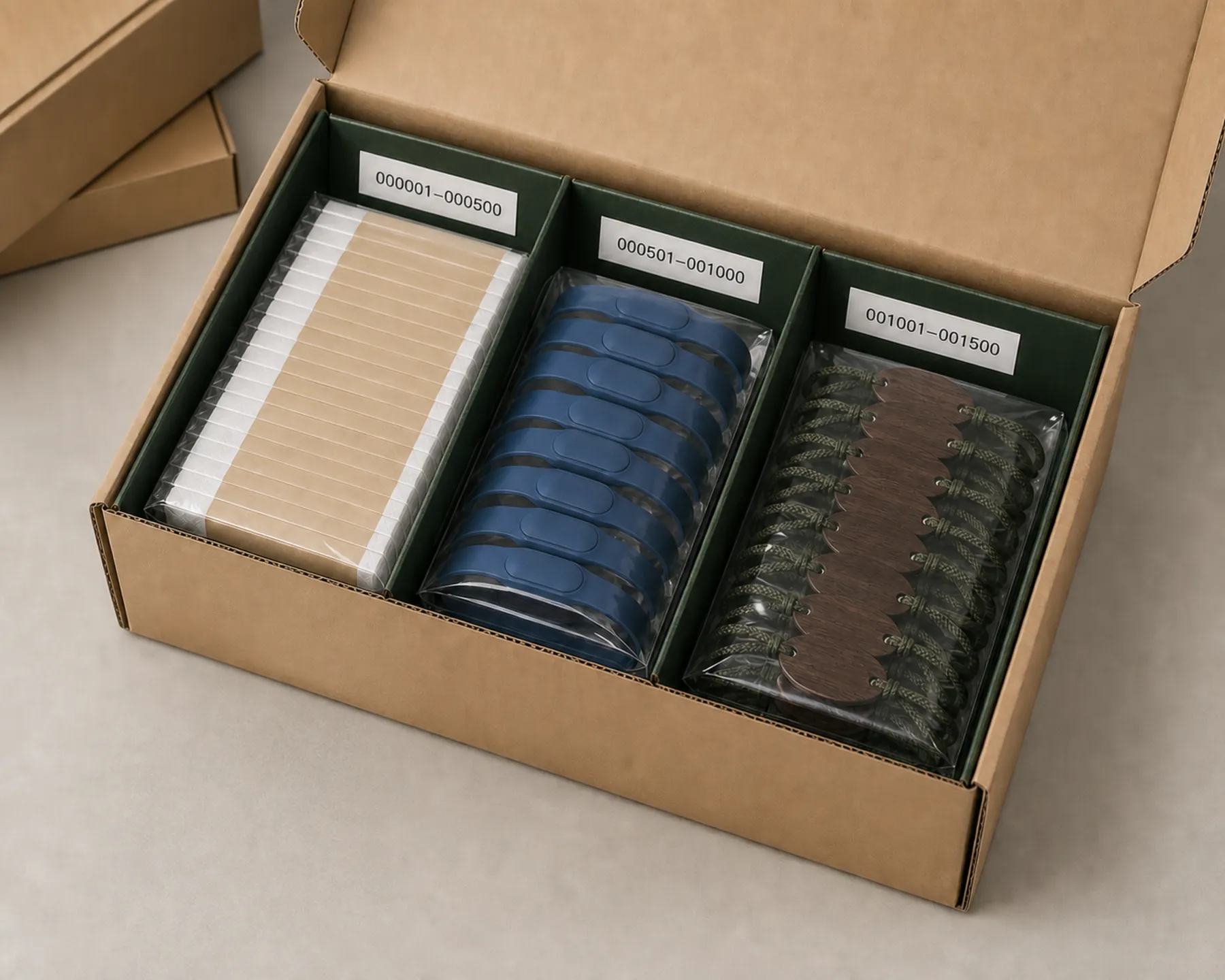
Counted, range-labelled supply does the same job at the other end: it lets a property record what arrived without opening everything, and it is what makes a credential estate auditable a year later. Both are decided at order time and neither can be retrofitted.
Why the object is small and the consequences are not
A wrong credential interrupts check-in, creates manual work at the pool, blurs access tiers, and makes a reorder impossible to reconcile. None of those failures look like a product problem while they are happening; they look like an operations problem.
A clear specification removes most of them, without pretending that a physical credential replaces the access platform behind it.