A day-pass programme succeeds or fails on one question a member of staff has to answer in three seconds, repeatedly, all day: does this person belong here right now?
- Two populations, one space
- Make the time boundary visible
- Transfer is the loss you are controlling
- Choosing the substrate
- The end of the day
Two populations, one space
Residents have already paid, elsewhere, and expect to walk in. Day visitors have paid at the door for a defined window. Staff have a queue and no time to read anything.
That argues for two visually distinct credentials rather than one credential with two states. Different colour and different construction can be told apart peripherally; a printed tier marker has to actually be read.
Make the time boundary visible
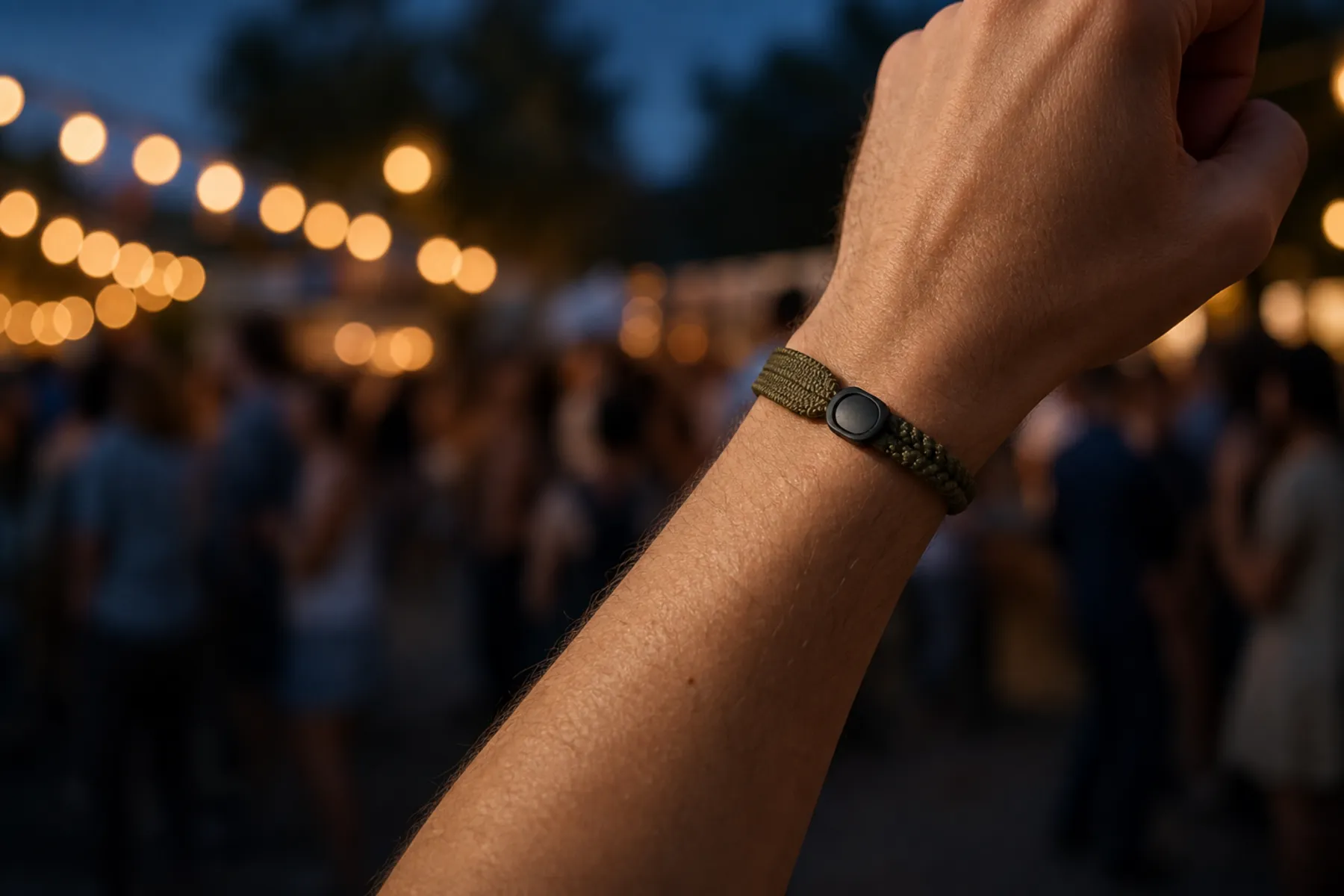
A system can expire a credential at 18:00. It cannot tell a member of staff at 18:30, across a terrace, that the guest at the bar bought a morning session.
Where sessions matter, the band has to show it — a colour per session, or a printed time on a desk-printed credential. The strongest pattern is colour by day plus a printed session: the colour stops yesterday’s band being used today, the print resolves which session was bought.
A day-colour system works only if a regular visitor cannot predict tomorrow’s colour. Agree the palette up front and rotate it out of sequence.
Transfer is the loss you are controlling
Not theft of a wristband — one paid admission worn by two people across an afternoon, handed over at an exit. An adjustable closure makes that effortless and invisible.
So day credentials use a one-way closure, fitting is final at issue, and the order carries an explicit misfit allowance because every wrong fit consumes a credential.
Choosing the substrate
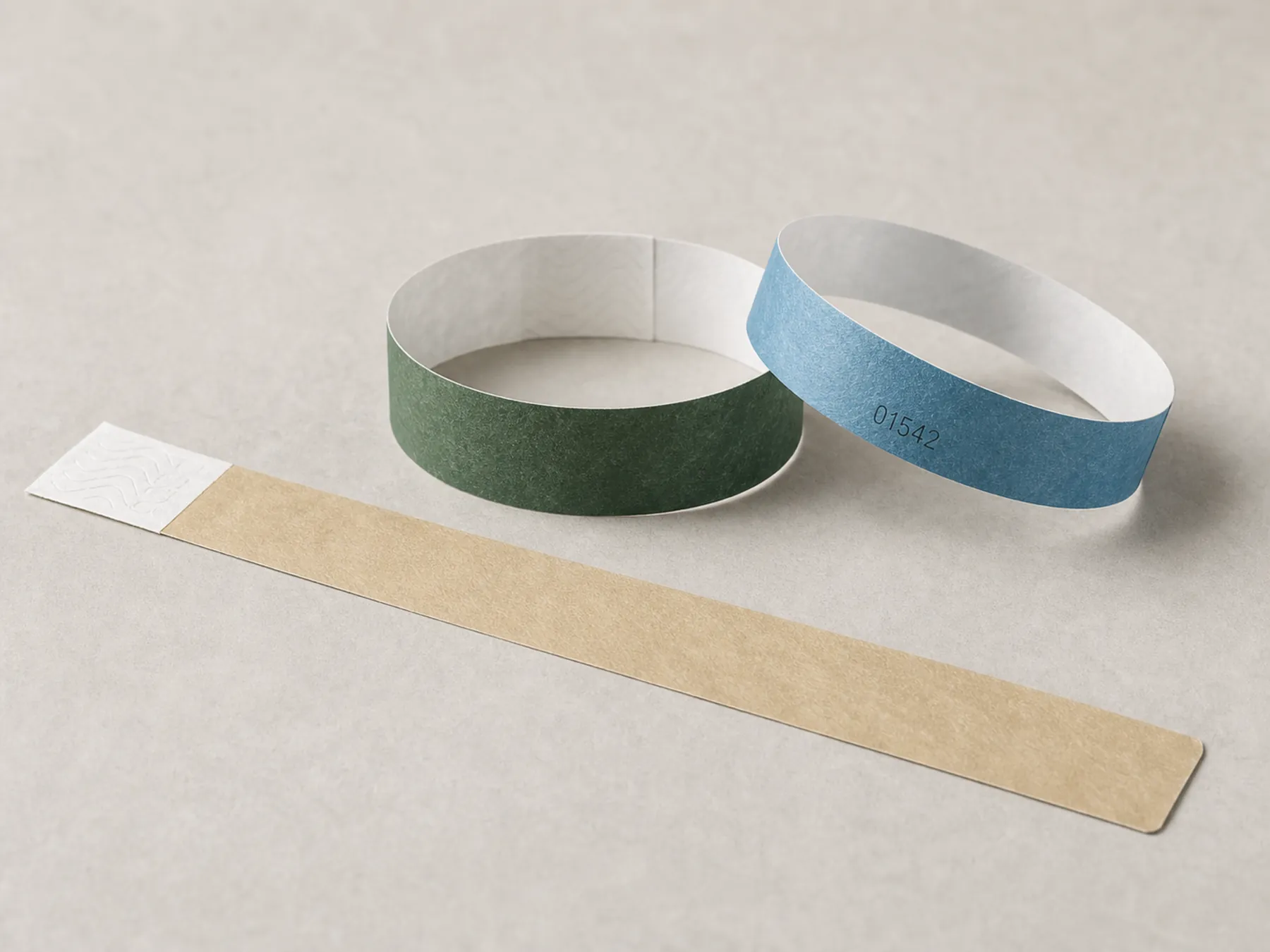
Anywhere with water, a tear-resistant synthetic band. Dry indoor sessions, coated paper with an inlay if the credential has to be machine-readable. Where each visitor needs different information printed — a name, a session, a package — a desk-printed thermal band.
Paper in a wet environment is the single most common day-pass mistake, and it produces an afternoon of reissues rather than a saving.
- Wet venues
- Tear-resistant synthetic — keeps full strength saturated
- Dry indoor sessions
- Coated paper with inlay, if machine-readable is needed
- Per-visitor data
- Desk-printed thermal band, printed at the point of issue
- Premium day programmes
- Moulded band, recovered at exit if the value justifies it
The end of the day
Day bands come off, and where they come off is a choice. Cutting stations and bins at exits keep the site clean and stop used credentials being recovered and re-presented on a later day.
If nothing is provided, they end up in the sand and the bar bins, which is both untidy and a small security gap.
Compatibility is confirmed against the property’s lock system, credential technology and encoding requirements before production. We do not claim universal compatibility.
Questions this raises
01One credential for residents and visitors, or two?+
Two. A distinct colour and construction can be read peripherally by staff with a queue in front of them, while a printed tier marker on a shared band has to be read — which is exactly what a busy gate cannot do.
02How do we stop a paid band being passed on?+
A one-way closure, accepting that fitting is final and every misfit consumes a credential. Anything reopenable — a snap, a buckle, a stretch loop — offers no transfer control at all.
03Can we use paper day bands at the pool?+
No. Paper stock weakens when saturated and tears at the wrist fold, often within hours. A tear-resistant synthetic band costs slightly more and removes an afternoon of reissues.