
The first order gets attention. The third one is placed by somebody who was not there for the first, against a memory, and that is where a credential estate quietly stops being consistent.
- What a reorder record has to hold
- What should trigger a fresh check
- When to reorder
- Who owns the record
- Natural materials and drift
What a reorder record has to hold
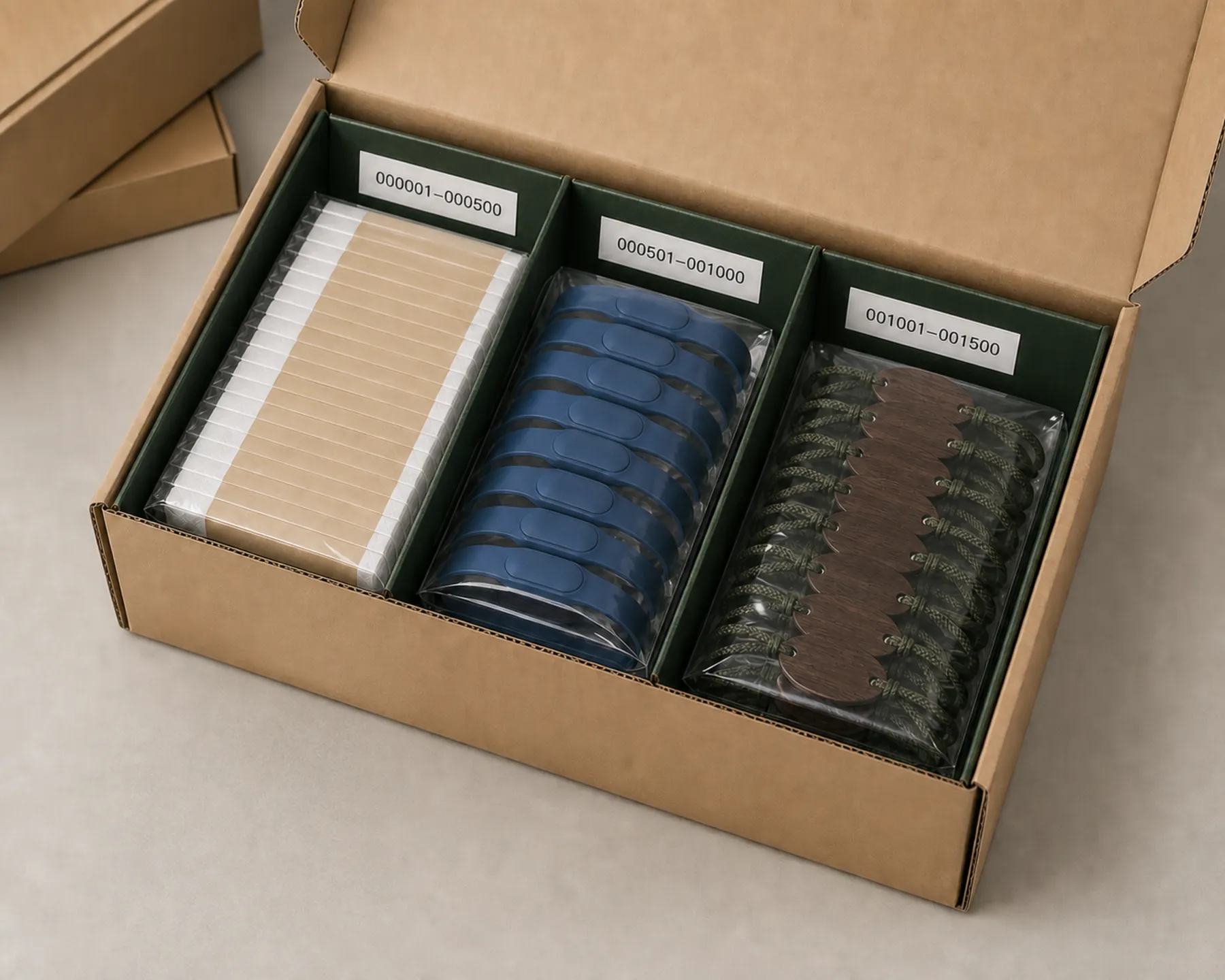
The approved physical sample. The artwork revision, by version rather than by filename. The colour reference as a standard rather than a name. The confirmed credential input. The packing and range-labelling instruction.
Five items. A reorder checked against those is a repeat; a reorder checked against a description is a new specification wearing the same name.
- Approved sample
- The physical reference, retained rather than returned
- Artwork revision
- Versioned, so "the logo" cannot silently become a newer logo
- Colour reference
- A standard, not a colour name — names drift between runs
- Credential input
- Technology, encoding convention and numbering range
- Packing
- Counted blocks and range labelling as originally supplied
What should trigger a fresh check
Any change to the credential type or encoding. Any change to material or component. A change of lock system or of integrator. A rebrand, however minor. A new colour. A different size split.
Each of those makes the run something other than a repeat, and treating it as a repeat produces a delivery that looks right and does not work — usually discovered at the desk on a busy afternoon.
When to reorder
Production is 14–21 days after artwork approval, and approval is not instant when a change has crept in. A property that reorders at the point of running low is a property that will run out.
The practical trigger is a stock level rather than a date: reorder when the remaining stock covers the production window plus the season’s reissue rate plus a margin, and count reissues so that rate is measured rather than guessed.
Remaining stock should cover the production window plus your measured reissue rate plus a margin. A date-based reorder ignores the season you are actually having.

Who owns the record
Somebody has to, by name. In most properties the credential order passes between operations, procurement and whoever is available, and the record survives only if it belongs to a role rather than to a person who may have moved on.
For groups, the record should sit with whoever approves for the group, so one property running low does not order alone and produce a subtly different run.
Natural materials and drift
Wood, cork, stone and recycled yarns vary between batches. That is why they are approved as a range rather than as a single target, and why the range travels in the reorder record.
A property that wants credentials issued three years apart to look identical should either choose a synthetic construction or accept a defined tolerance. Both are reasonable; assuming identity from a natural material is not.
Compatibility is confirmed against the property’s lock system, credential technology and encoding requirements before production. We do not claim universal compatibility.
Questions this raises
01Why did our reorder come back different?+
Almost always because something changed and was treated as a repeat — a credential type, a component, a colour reference given as a name rather than a standard, or a logo that was quietly updated. That is what the reorder record exists to catch.
02How early should we reorder?+
When remaining stock covers the 14–21 day production window plus your measured reissue rate plus a margin. Reordering when you notice you are low is reordering too late, because approval is not instant if anything has changed.
03Can you hold stock for us?+
Reorders are produced against the recorded reference rather than drawn from held stock, which is what keeps a repeat run identical to the approved one. That means the production window applies to reorders as well as to first orders.