
Start from the guest map, not the product
Every all-inclusive specification we have worked on that went wrong went wrong in the same place: the property chose a band, then discovered it had four populations that could not all wear the same one. Resident adults, children, day visitors and staff have different wear periods, different security requirements and different comfort constraints, and one construction rarely satisfies all four.
The map that resolves it is short. For each population: how long do they wear it, what may they open, what may they charge, and what happens when it is lost? Four questions, four populations, and the answers determine the construction, the closure, the colour logic and the quantities before anyone looks at a sample.
The four populations, and what usually differs:
- Resident adults — full stay, room plus spend, comfort matters most, reissue must be fast
- Children — closed-loop construction, no spend, parent-linked, safety before convenience
- Day visitors — time-bounded, visually distinct, transfer is the risk to control
- Staff — months of wear, role-based access, credential changes faster than the band does
The credential is worn in water, so start there
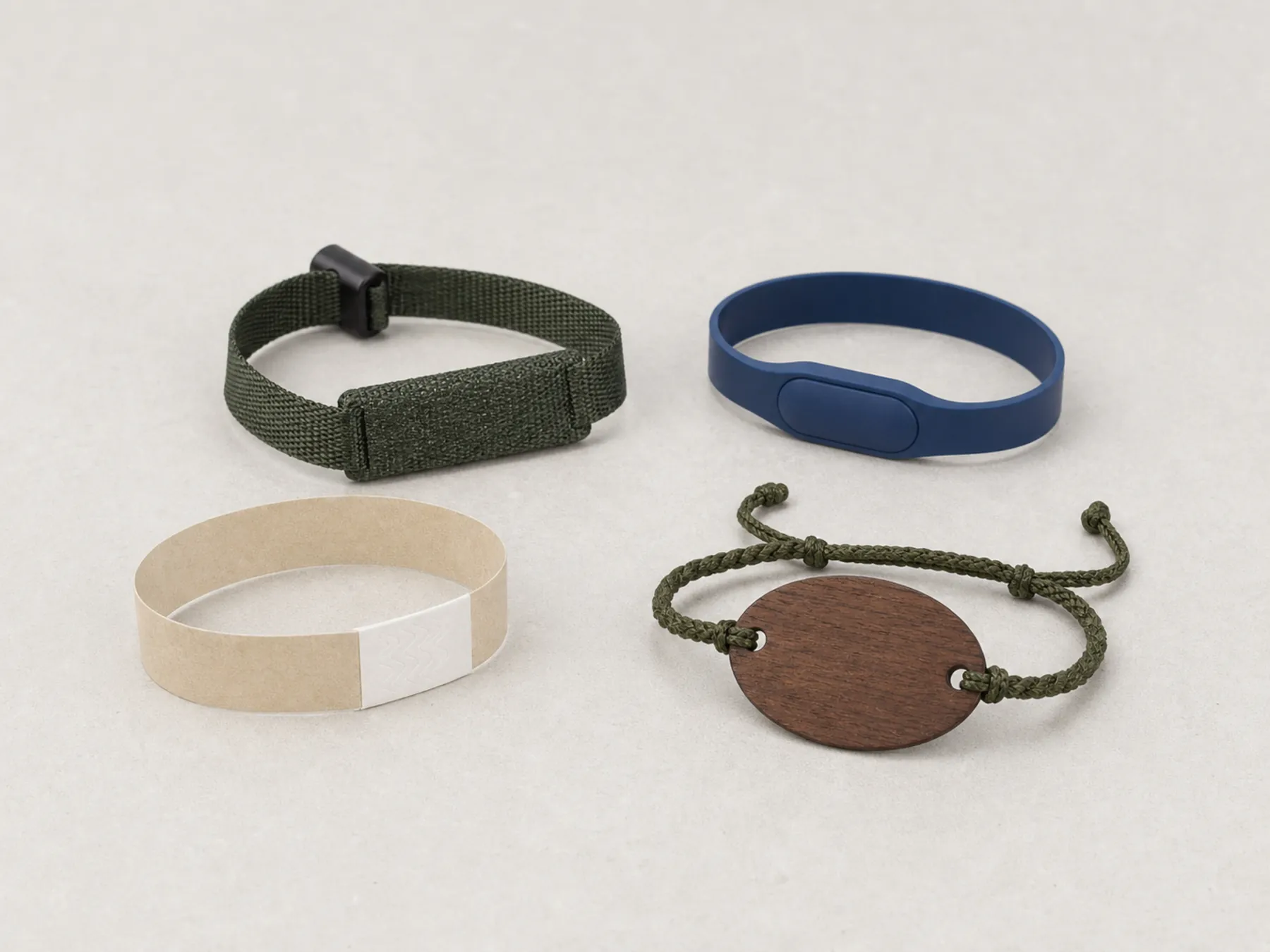
At an all-inclusive the pool is not an occasional event, it is where the guest spends the day. That single fact removes several constructions from consideration: fabric bands that stay damp, wood faces that dislike immersion, adhesive day bands that fail wet. What is left is moulded silicone for most residents, with the natural-material options reserved for evening or premium tiers.
It also changes how a property should test. A read test at reception proves nothing about a wet guest presenting a band one-handed at a locker bank while holding a towel, which is the actual condition. That test belongs in the sample stage.
Cashless spend is a platform question wearing a product costume
Properties often arrive asking for a wristband that does cashless payments. The band does not do payments — it carries an identity, and the property’s own platform decides whether that identity may charge to a folio. What we can do is make sure the physical credential is right for the environment where it will be presented, and that the identity is issued in a way the platform can consume.
The practical questions are about exceptions rather than the happy path. What happens when the platform is offline at a beach bar? Who can authorise a charge on a lost band? Is there a spend limit per guest type, and does the band show that limit to a member of staff? Those answers shape the visual system more than the technical one.
Losing a credential at 11pm
This is the operational test of an all-inclusive credential programme, and it happens nightly. A guest returns from a beach bar without their band. The desk has to identify them, disable the old credential, issue a new one, restore their spend permissions and get them into their room — ideally in under three minutes and without waking a manager.
A property that has not rehearsed that will discover its credential choice was wrong at the worst moment. It is also the reason to hold reissue stock in a plain colourway that is visually identical to the main run: a guest who has lost a band should not spend the rest of the week wearing something that marks them out.
Before the first full order, walk the reissue through end to end at 11pm with real staff. It surfaces missing stock, missing authority and missing steps far more reliably than a specification review does.
Housekeeping finds them, and that is a system
Bands are left in rooms, by pools and in laundry. Housekeeping will recover a meaningful number every week, and without a route for them the recovered bands accumulate in a drawer, still enabled, which is the quiet security failure in most resort credential programmes.
The fix is procedural and small: a defined collection point, a defined person who reconciles recovered credentials against the system, and a defined disposal or cleaning route. It costs almost nothing and it is the difference between a credential system and a box of live keys.
Tier colour, and the trap in it
Colour is the fastest way for staff to read entitlement across a busy pool deck, and the most common way for a property to paint itself into a corner. A palette agreed for four tiers cannot easily become five in August, because a moulded colour is a production run rather than a print file.
Two habits avoid it: agree the full palette at the first order including tiers you do not yet run, and keep one flexible tier in a printed or day-credential format that can absorb whatever the season invents.
Seasonal peaks and the quantity conversation
Occupancy is not the order quantity. The quantity is driven by artwork count, colourway count, size split, reissue rate and whether bands are recovered — and each of those multiplies rather than adds. A property with two artworks, four tier colours and three sizes is running twelve separate counts, which is a very different conversation from “we have 400 rooms”.
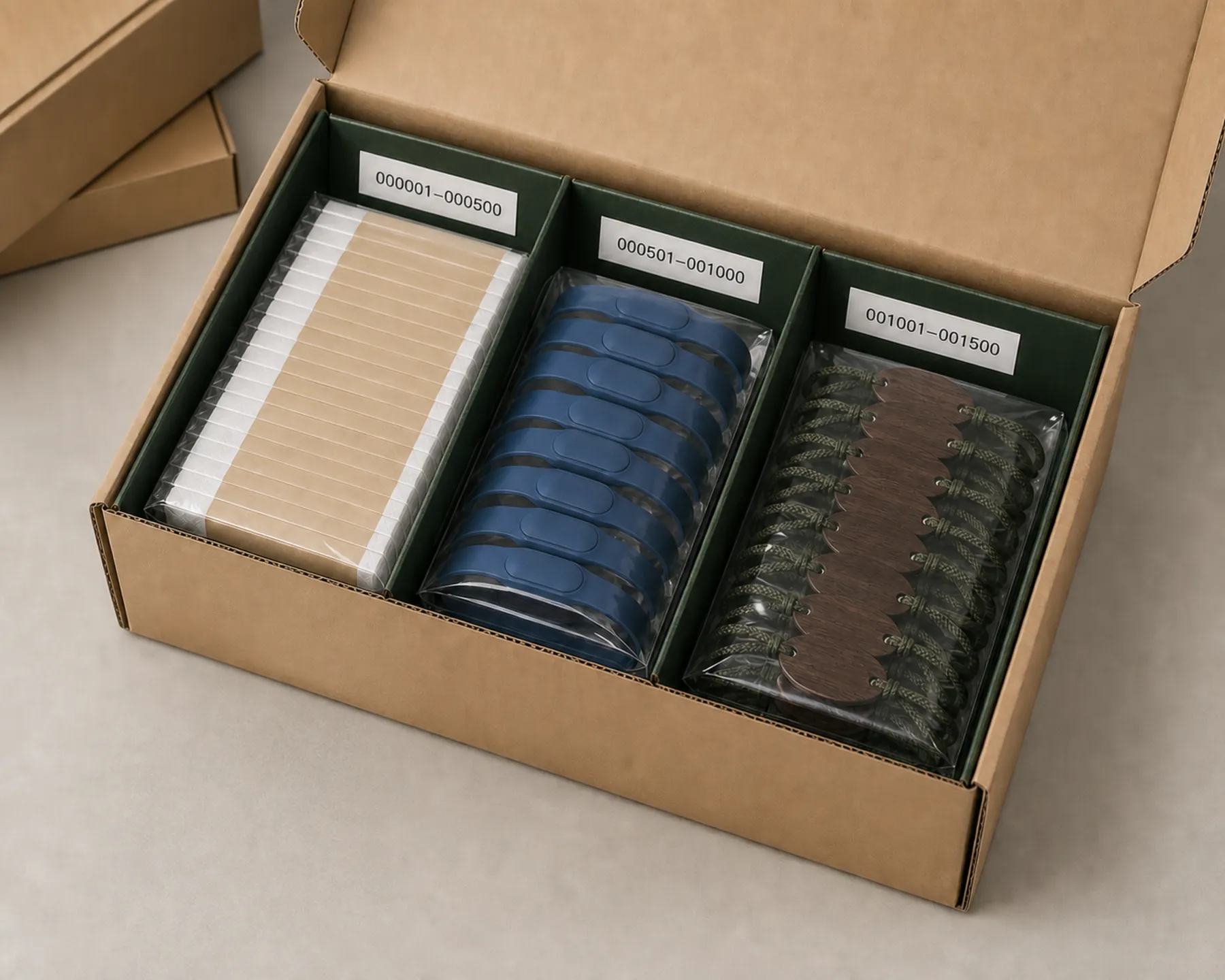
Minimum order is 500 pieces per artwork with 14–21 days production after artwork approval, so a property planning a season needs the tier and artwork map settled well before the peak rather than during it.