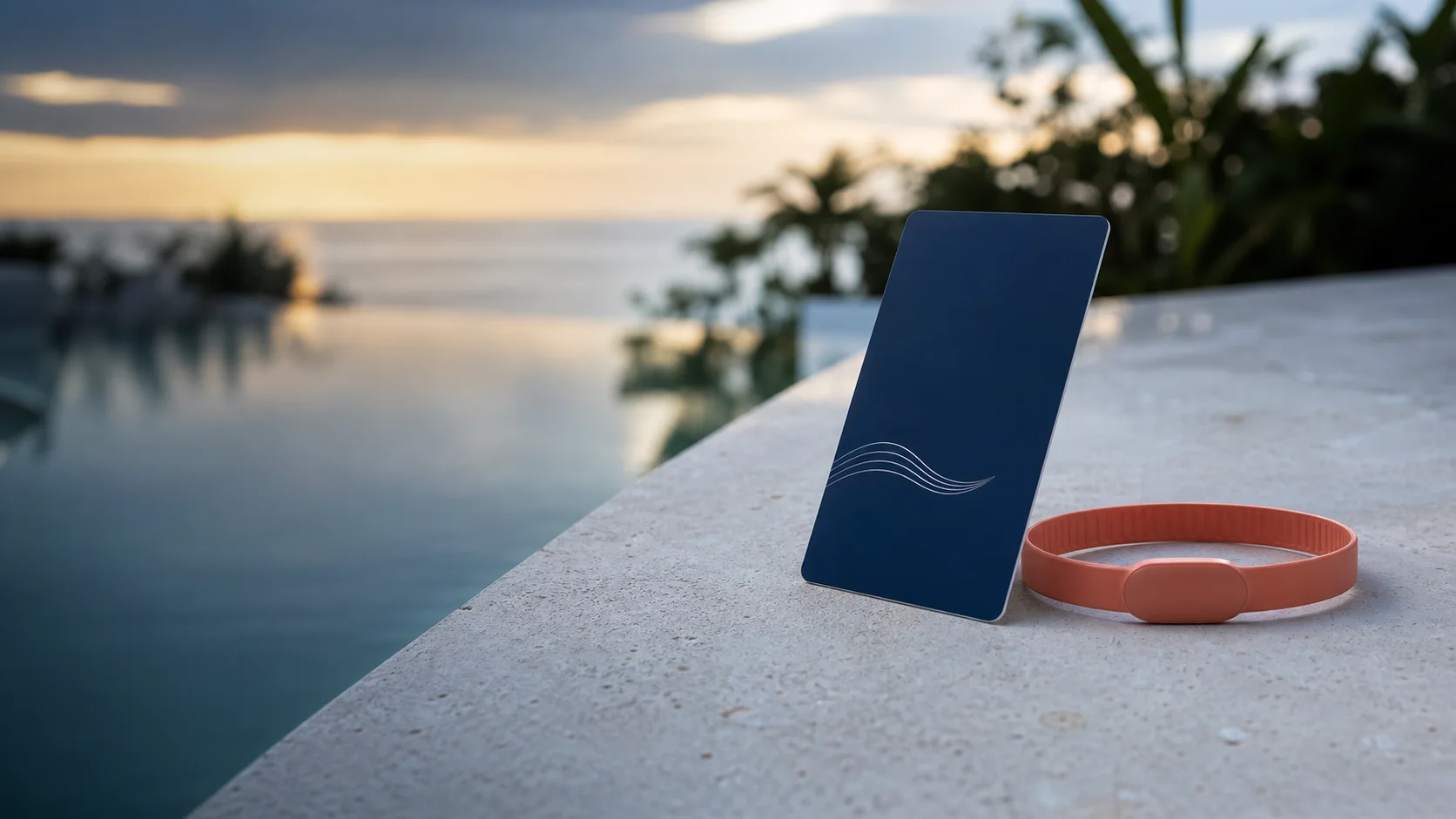
These are volume operations. A large all-inclusive issues, loses and reissues credentials at a rate that makes small procedural decisions expensive — and the wet season decides when the ordering has to happen.
- Throughput changes which problems matter
- Cashless is normal, and the exceptions are the design work
- Day visitors and external sales
- Planning around the wet season
- Children are a large share of guests
- Receiving, documentation and who imports
Throughput changes which problems matter
At a property issuing hundreds of credentials a day, a procedure that takes ten seconds longer is an hour of desk time daily, and a reissue rate one point higher is thousands of credentials a season.
That is why the operational decisions here — how a band is fitted, whether housekeeping has a route for recovered credentials, whether reissue can be done by one person — matter more than the construction choice, which at this scale is usually a moulded band and not a difficult decision.
Cashless is normal, and the exceptions are the design work
All-inclusive properties here commonly run folio-linked spend, which means the credential is presented dozens of times a day at bars and outlets rather than twice at a door. That argues for a construction that keeps the credential in a predictable position on the wrist and reads on first presentation.
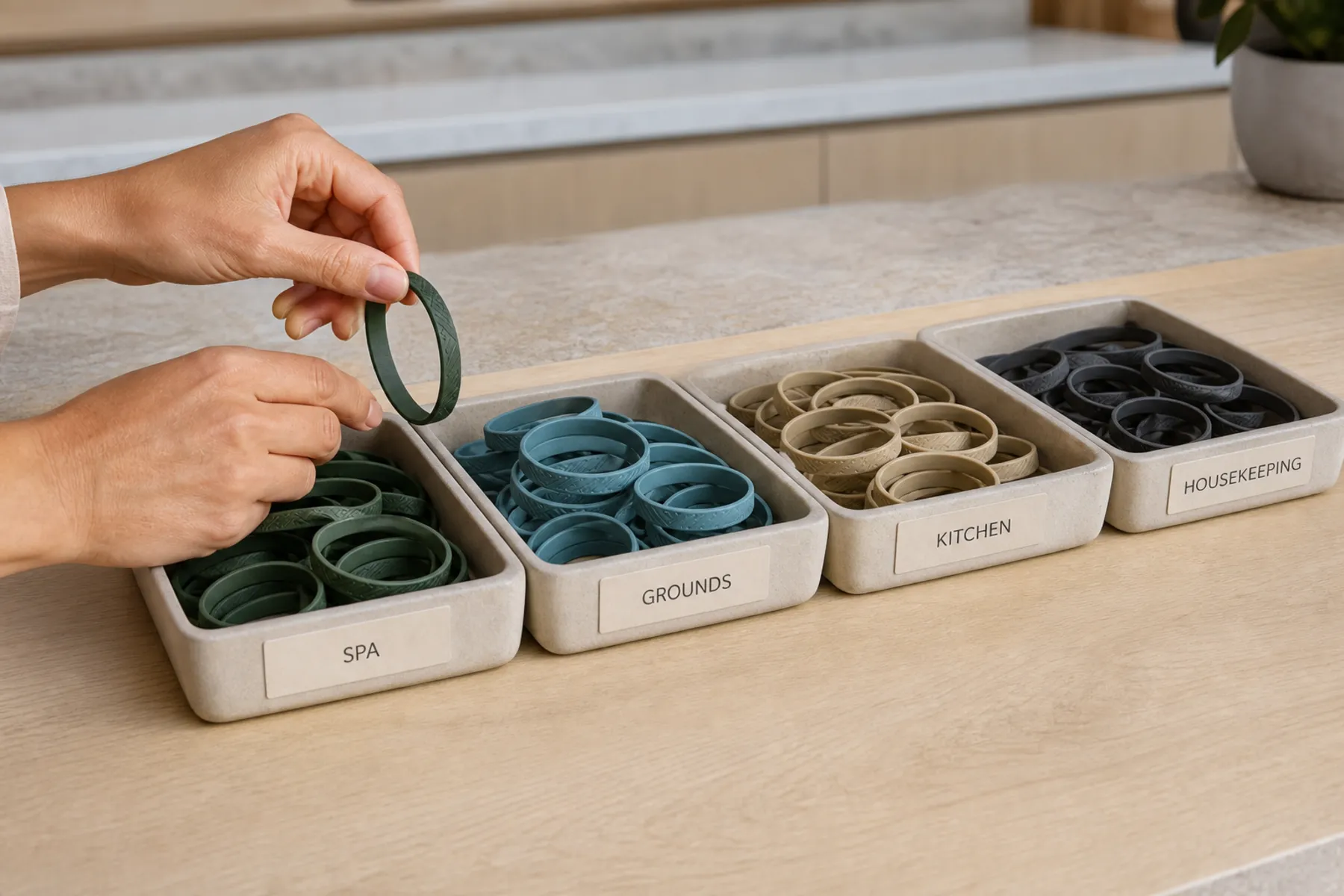
The design work is in the exceptions: an offline outlet, a guest without a band, a child who should not be able to charge, a departing guest whose folio has closed. Each needs an answer a server can execute without calling a manager.
Every cashless programme works when everything works. What guests remember is what happened when the platform was offline or the band was lost — which is a procedure question, not a product one.
Day visitors and external sales
Day-pass sales to non-residents are a significant business at many properties here, which puts two populations through the same facilities. A visually distinct day credential with a one-way closure is the standard answer, because transfer — one admission worn by two people — is the loss being controlled.
Where the property sells timed sessions, the band should show the session as well as the system enforcing it, since a member of staff at a bar cannot query a system across a terrace.
Planning around the wet season
The wet season affects both operations and logistics, and the practical consequence for credentials is that ordering should not be left until the period when everything else is also disrupted.
We do not publish transit times or duty figures — they change by shipment and by date, and a number here would be wrong for somebody. What we would say is to place season orders early enough that a delayed shipment is an inconvenience rather than a shortage, and to hold reissue stock accordingly.
Children are a large share of guests
Family volume is high, which makes closed-loop children’s credentials a routine rather than an exception. That means the desk holds sizes, staff use a gauge rather than judgement, and the stock split is weighted towards the middle sizes.
It also means a child credential that cannot charge has to be visibly different, so a server can see it before presenting it rather than after a decline.
Receiving, documentation and who imports
Each destination has a party responsible for importing, and for a group that is not always the property. Establishing who it is before the order removes the most common cause of goods waiting while responsibility is worked out.
Documentation needed in a particular language or format should be requested at the specification stage. We supply what accompanies goods and do not act as importer.
Compatibility is confirmed against the property’s lock system, credential technology and encoding requirements before production. We do not claim universal compatibility.
Questions this raises
01What matters most at high volume?+
Procedure rather than product. At hundreds of credentials a day, ten seconds per issue is an hour of desk time, and a slightly higher reissue rate is thousands of credentials a season. The construction is usually the easy decision.
02How should a cashless programme handle exceptions?+
By deciding them in advance: what a server does when the platform is offline, who authorises a charge for a guest without a band, how a child credential is visibly prevented from charging, and how fast a lost band is disabled at 11pm.
03When should we order for the season?+
Early enough that a delayed shipment is an inconvenience rather than a shortage. We do not publish transit times because they change by shipment and by date — the planning principle is margin, not a number.