Sustained heat and direct UV are harder on a credential than water is, and in this region they are constant for months. Colour stability stops being cosmetic and becomes an operational requirement.
- UV is the dominant material exposure
- Heat, not just sunlight
- An inverted season
- Indoor and outdoor are different environments
- Large properties, large staff populations
- Design restraint and guest expectations
UV is the dominant material exposure
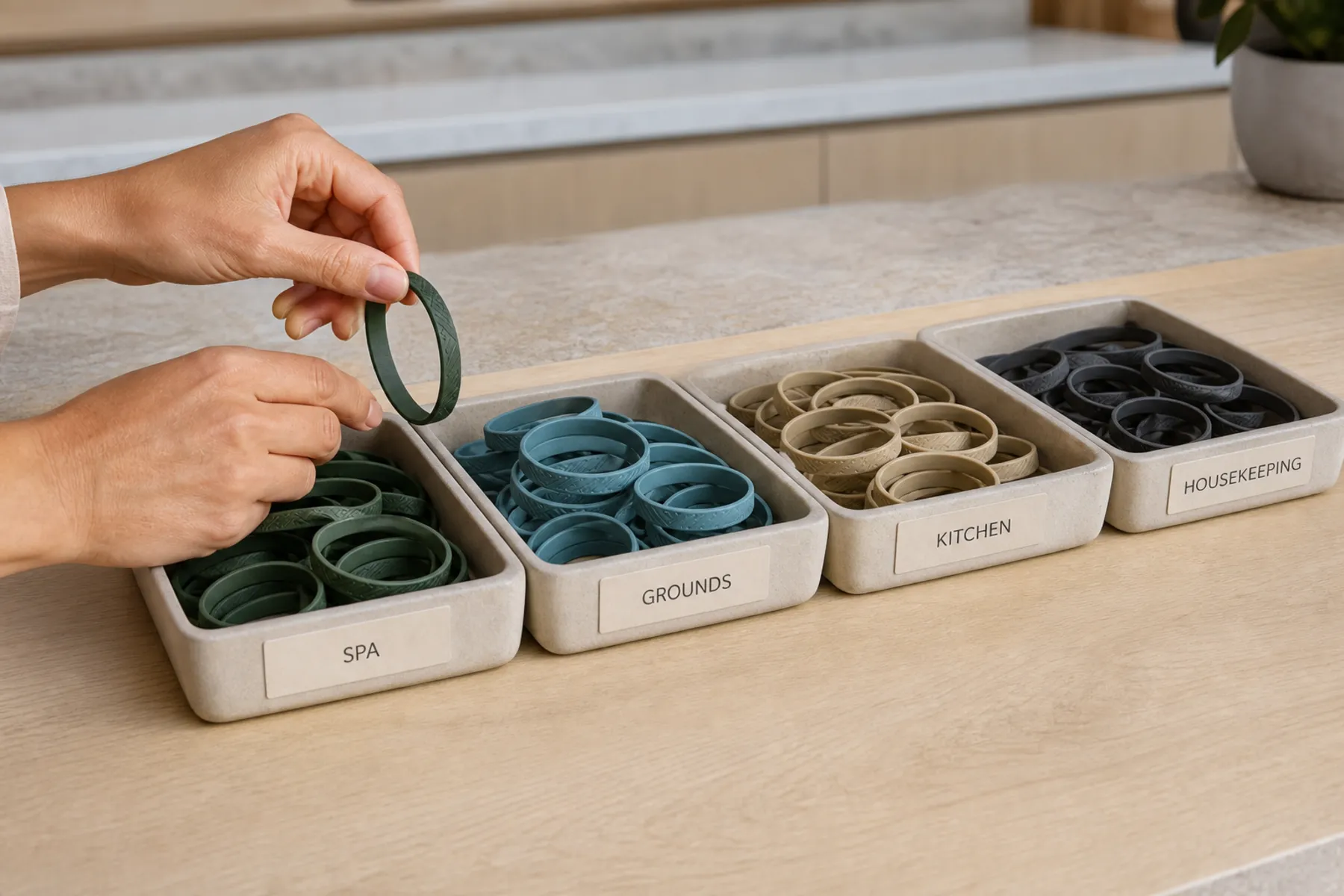
Months of intense direct sun shift pale and fluorescent pigments first, and unevenly because a band rotates on a wrist. On a property where colour identifies a guest tier, a zone or a session, that is a control failure rather than a cosmetic one.
Palettes chosen on strong hue contrast survive; palettes built on tonal differences do not. Debossed and moulded marks survive; printed layers become patchy. Neither of those is expensive to specify at the start and neither can be fixed mid-season.
Where colour carries meaning, leave sample bands in direct sun for a period and re-check the separation before committing a tier system to a palette.
Heat, not just sunlight
Surfaces reach temperatures that make a credential uncomfortable to put on, and stock stored in an unconditioned area is heat-cycled daily. Adhesive closures behave differently, direct-thermal printed credentials darken, and any assembly relying on an adhesive bond is being tested continuously.
Desk-printed thermal day credentials in particular should be specified with care here: the image stays heat-sensitive after printing, and a band left in a car or in direct sun can become unreadable within an afternoon.
An inverted season
Peak demand sits in the cooler months and the deepest low is in high summer, which is the reverse of most resort markets. That matters for ordering rhythm: the natural window to place a season order is the one where the property is quietest, which here is the hottest part of the year.
It also affects storage. Stock ordered for the season ahead may sit through the hottest months, which is an argument for sealed, conditioned storage rather than a back-of-house room.
Indoor and outdoor are different environments
Many properties here operate an air-conditioned indoor world and an intense outdoor one, and guests move between them constantly. Credentials go from a cold interior to direct sun repeatedly, which is a thermal cycle of its own, and condensation on a cold credential in humid coastal air is a real rather than theoretical effect.
Reader placement follows the same split: an outdoor reader in bright sun often has an indicator nobody can see, which produces repeated presentations and a queue. It is worth checking with the installer rather than blaming the credential.
Large properties, large staff populations
Properties at this scale run staff populations of a size where credential turnover is continuous rather than seasonal, across many nationalities, contractors and departments.
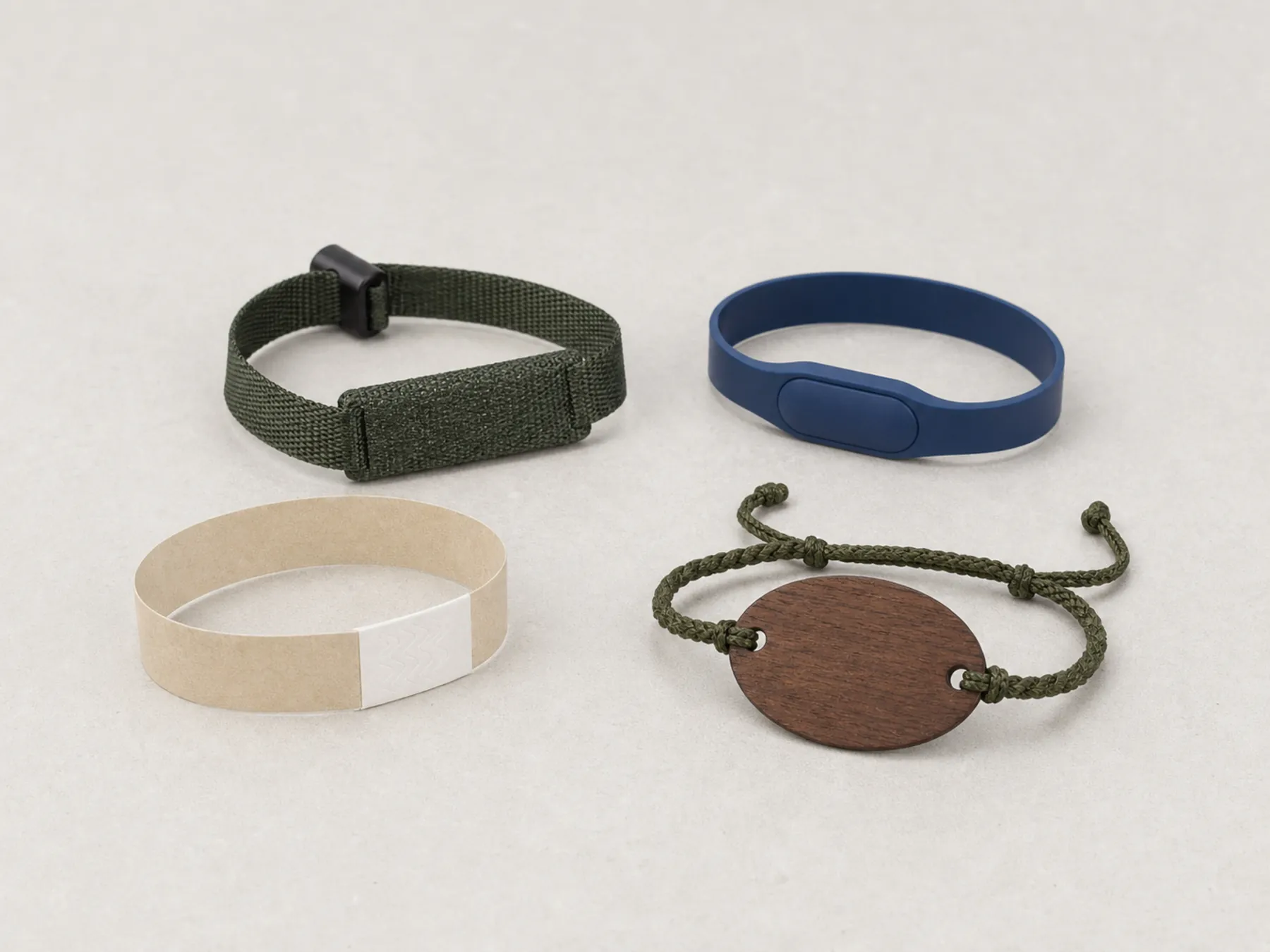
That is the clearest case in the whole range for a replaceable-credential construction: bands become stock and credentials become issue items, so a departure withdraws a credential rather than discarding hardware. It also puts the emphasis on the disable-on-leaving procedure, which matters more than any construction decision.
Design restraint and guest expectations
Properties in this region frequently sit at the top of the market and are unusually attentive to how a credential looks in a lobby. That pulls towards discreet constructions — a slim band, a card in a holder, a concealed module — and away from anything that reads as leisure equipment.
Where the property also runs a beach club or water park, the answer is two constructions from one artwork family rather than a compromise that suits neither.
Compatibility is confirmed against the property’s lock system, credential technology and encoding requirements before production. We do not claim universal compatibility.
Questions this raises
01What fails first in this climate?+
Colour, then anything relying on an adhesive bond. Sustained UV shifts pale pigments unevenly, which breaks tier systems built on tonal differences; heat cycling works continuously on adhesives and on direct-thermal printed images.
02Are desk-printed day bands suitable here?+
With care. Direct-thermal images stay heat-sensitive after printing, so a band left in a car or in direct sun can darken to unreadable within an afternoon. For multi-day passes, a pre-printed synthetic band is the better specification.
03When should we place a season order?+
In the quietest period, which here is the hottest part of the year — and store the stock sealed and conditioned rather than in a back-of-house room, since it may sit through the peak of the heat before the season starts.