A worked planning scenario, not a customer project. No property or group is described and none is implied.
- The conditions
- Separate the branding question from the technical one
- One artwork, colour per property
- The record is the group asset
- Import and documentation, per destination
The conditions
Six properties across two countries, presented to guests as one brand. Three different lock systems, because four of the properties were acquired rather than built. Each property has ordered its own credentials at different times from different suppliers. Nobody holds a shared record.
The presenting problem is that the credentials no longer look related, and each property is ordering its own 500 pieces.
Separate the branding question from the technical one
These are two decisions that get discussed as one. The branding decision is whether the group shares an artwork; the technical decision is what each property’s installation accepts. A shared artwork works perfectly well across three lock systems, because the artwork is not what the reader sees.
Assuming the group is technically homogeneous is the expensive mistake. Confirming per property is unglamorous and prevents the failure that costs a whole run.
One artwork, colour per property
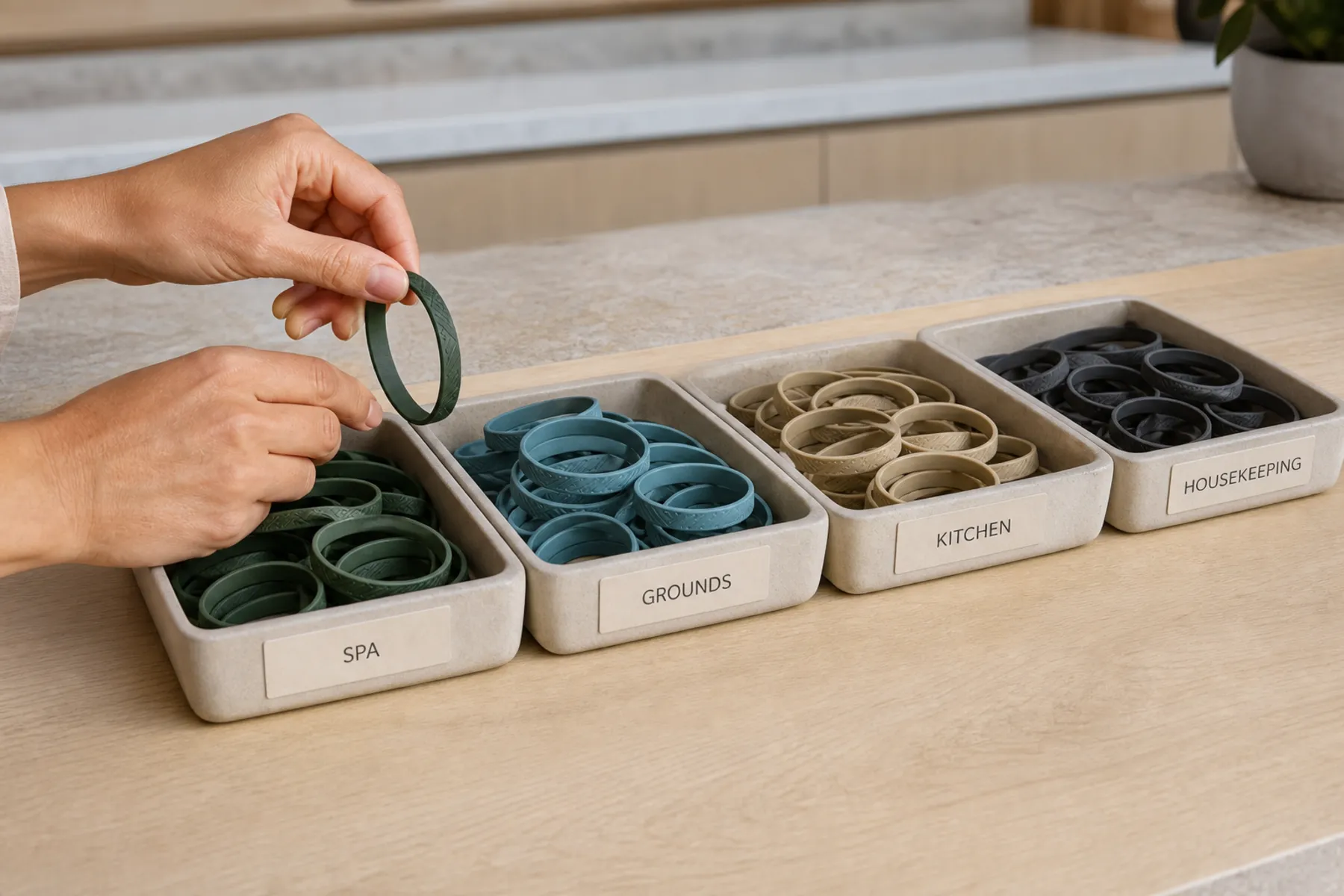
Because guests see one brand, a shared artwork with a colour per property is both cheaper and more coherent than six designs. Six counts becomes one or two, and the properties finally look related.
Where one property genuinely needs a different construction — a beach club operation among five city-adjacent hotels — that is a construction difference within the same artwork family rather than a separate design.
- Before
- Six designs, six suppliers, six records, six minimum orders
- After
- One artwork family, colour per property, one central record
- Unchanged
- Per-property credential confirmation against three different systems

The record is the group asset
One party approves artwork and holds the reorder record: approved sample, artwork revision, colour reference, credential input and packing instruction. It should belong to a role rather than a person, because credential ordering passes between whoever is available.
Without it, the first property to run low orders alone and the group acquires a second, subtly different run of the same credential — which is exactly how it got here.
Import and documentation, per destination
Two countries means two importing arrangements, and in a group the responsible party is frequently a management company rather than the property. Establishing who it is per destination before ordering removes the most common cause of goods waiting while responsibility is worked out.
Documentation needed in a particular language or format is collected once at the specification stage rather than discovered at each delivery.
One artwork, six colourways, ordered centrally and distributed — with credential type confirmed per property, and one record held by a role rather than a person.
Compatibility is confirmed against the property’s lock system, credential technology and encoding requirements before production. We do not claim universal compatibility.
No named hotel or customer project is used as proof anywhere on this site. The reasoning behind that is set out on the about page.