A worked planning scenario, not a customer project. No property is described and none is implied.
- The conditions
- The band is a safety artefact
- Construction follows the abuse, not the water
- The inspection step nobody budgets for
- What the credential actually does
The conditions
A four-month season, several thousand admissions on a peak day, lockers and cashless food outlets, and ride eligibility determined by height. Roughly half the admissions are children. Bands are recovered at the exit and reissued the following day.
The presenting problem is a mid-season failure rate that nobody has quantified and a colour system that stops being readable by August.
The band is a safety artefact
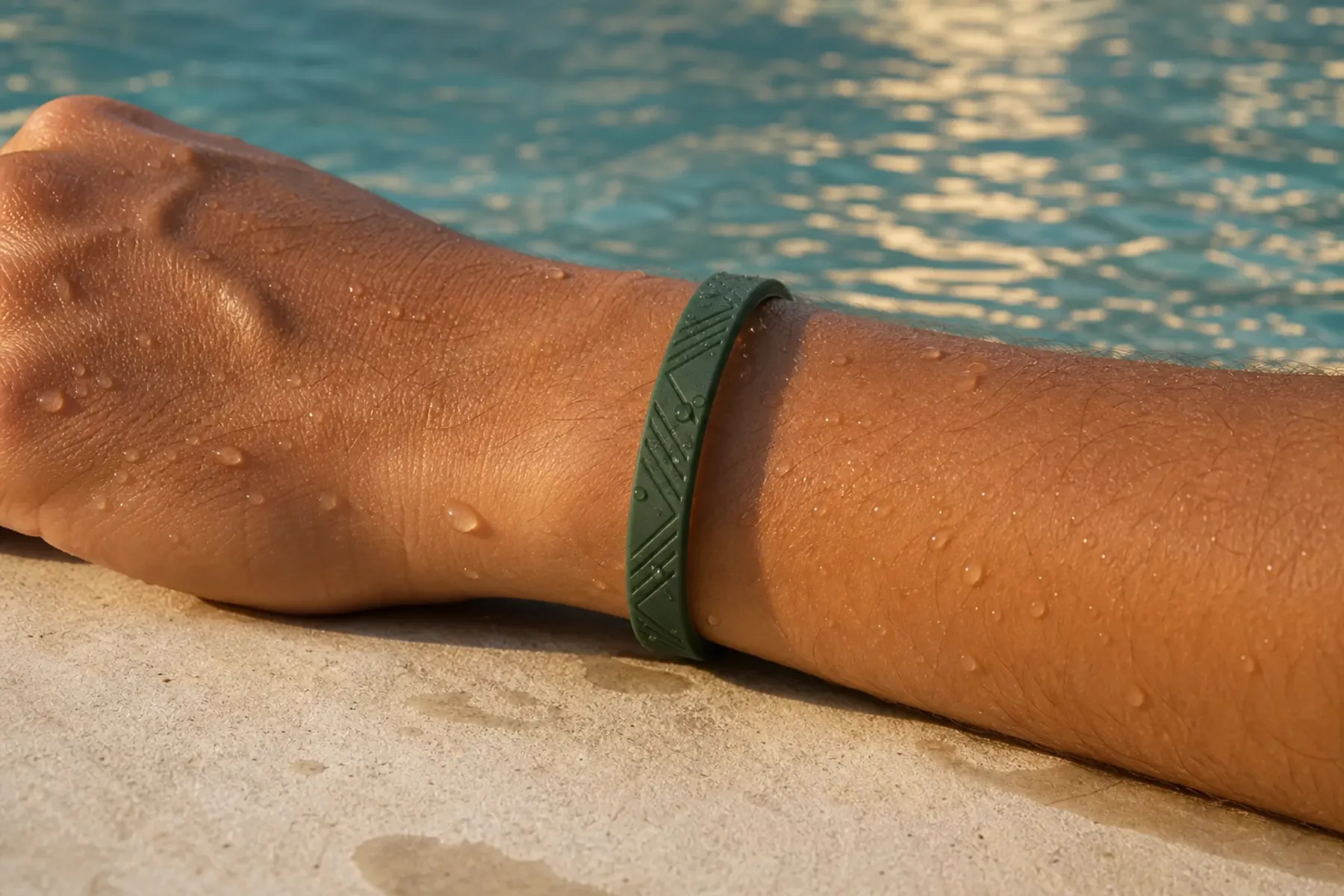
Because colour carries ride eligibility, a band that has faded or been swapped has a safety consequence rather than a commercial one. That raises the requirement on two things: colour that stays separable through a season of direct sun, and a closure a child cannot open.
Categories chosen on strong hue contrast survive; categories separated by tone do not. Checking the palette wet as well as dry matters, because wet material reads darker and can collapse the difference between two similar colours at exactly the moment an attendant needs it.
Construction follows the abuse, not the water
Chlorine does very little to a moulded band. The failures are mechanical: an elongating post hole from a forced closure, and a lifted edge where the face meets the strap after a hard pull.
So the specification is a heavy section concentrated at those two points, an oblate face whose long axis lies along the wrist, and reinforced post holes that tolerate being fastened in a hurry.
- Adults
- Heavy-section adjustable band, reinforced closure, debossed mark
- Children
- Closed loop from the same artwork, sized at issue with a gauge
- Categories
- Colour on hue contrast, checked wet, approved after sun exposure
- Cycle
- Recover, clean, inspect, retire — with two named failure signs
The inspection step nobody budgets for
A recovery cycle only works if bands leave circulation when they should. Two visible signs cover almost all of it: a post hole beginning to elongate, and a lifted face edge. Staff need both signs and the authority to act on them.
The attrition that produces is a quantity decision taken before the season rather than discovered in July, and it is the number most often left out of a season order.
What the credential actually does
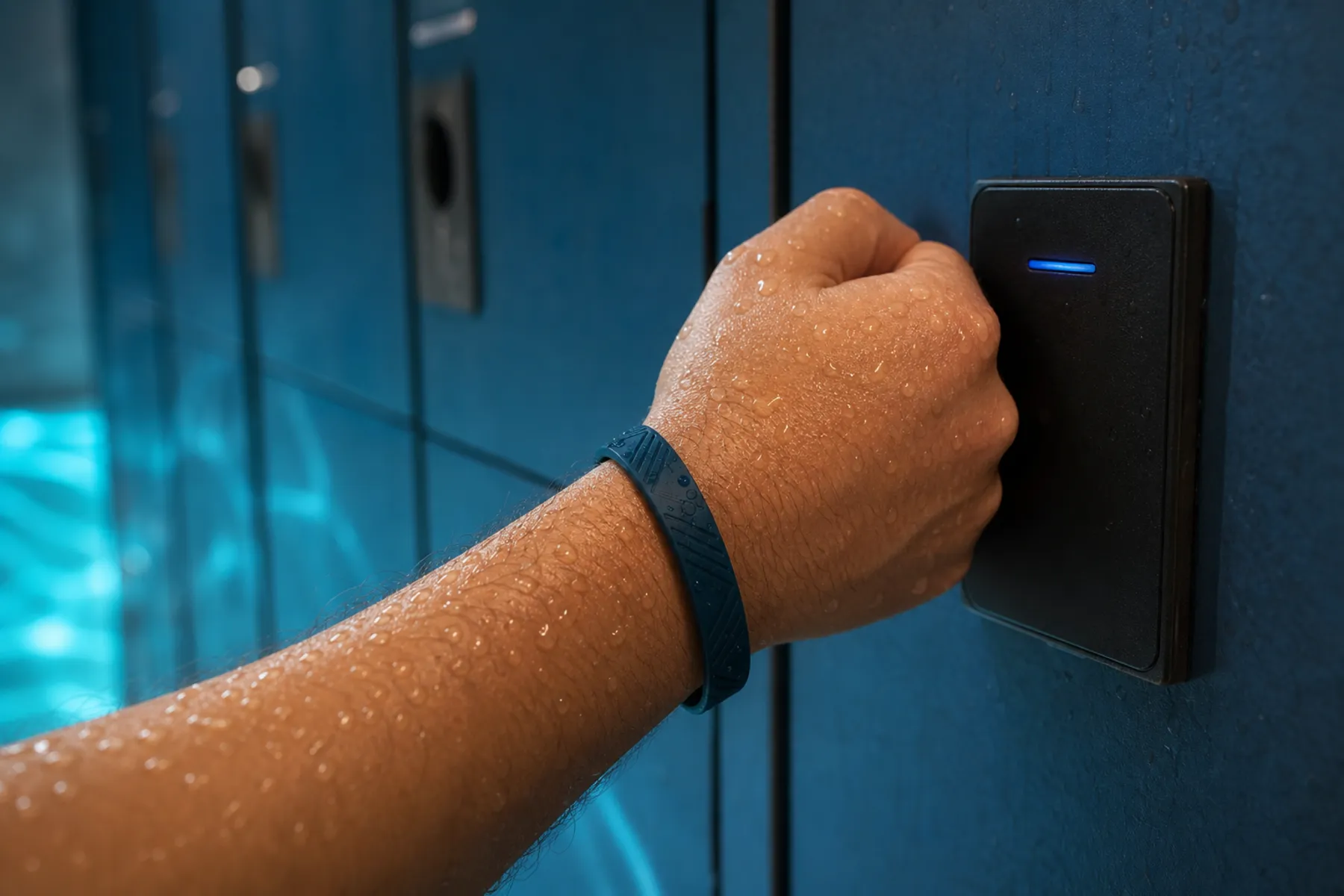
Not doors. Lockers and food outlets, presented by a wet guest in motion with one free hand, often with a child attached to the other. That is the read test that matters, and it is not the test a desk unit performs.
What the credential is permitted to do at a point of sale is set by the property’s own platform; the band carries the identity and has to survive presenting it a dozen times a day.
One artwork across adult and youth parts, a colour per height category agreed and sun-tested before the season, plus an explicit attrition allowance for mid-season retirement.
Compatibility is confirmed against the property’s lock system, credential technology and encoding requirements before production. We do not claim universal compatibility.
No named hotel or customer project is used as proof anywhere on this site. The reasoning behind that is set out on the about page.