Buyers ask about chlorine. In service, the things that shorten a credential’s life are mechanical wear at the closure, salt crystallising as a band dries, and UV on pigment — roughly in that order.
- Chlorine, in perspective
- Salt does its damage while drying
- UV works on colour before it works on material
- Sunscreen and body oils
- Heat cycling is the underestimated one
Chlorine, in perspective
At the concentrations a swimming pool runs, chlorine does very little to moulded silicone, welded vinyl or a sealed module. Bands recovered at the end of a season at a busy pool are almost never failing chemically.
What they are doing is accumulating residue in recesses and dulling where they drag against surfaces. Both are cosmetic, both are largely reversible with a rinse, and neither is what takes a band out of circulation.
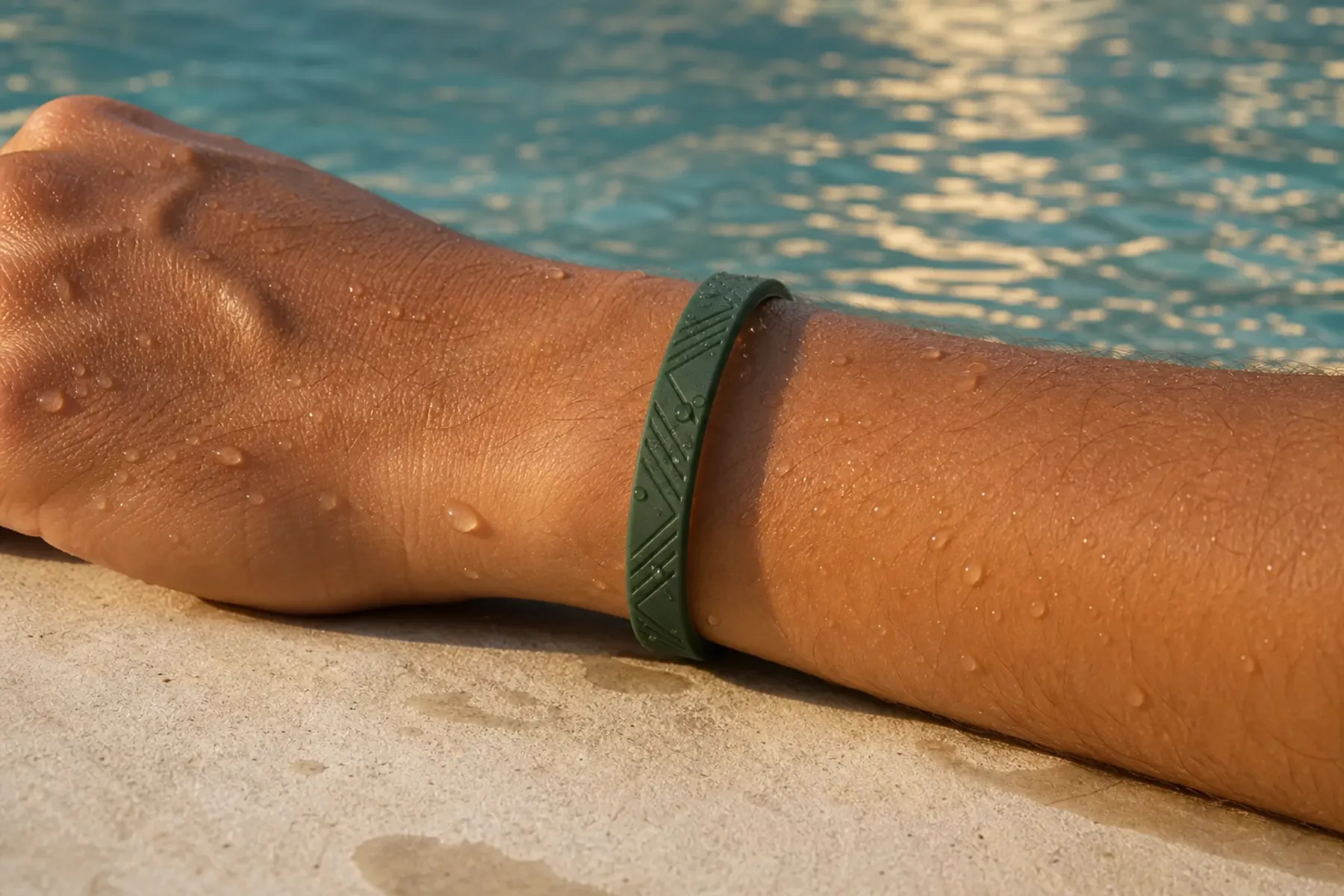
Salt does its damage while drying
Sea water is not the problem; the salt left behind as it evaporates is. Crystals stiffen cords and braids and abrade fibres from the inside, which is why a beach band ages faster than a pool band despite being wet less often.
The whole mitigation is a fresh-water rinse. For guest-worn bands that is one sentence at check-in; for recovered stock it is a step before storage, and it makes a season-long difference at no cost.
Rinse after sea swimming. It is the single highest-value piece of guest guidance for any coastal credential programme, and it costs nothing to give.
UV works on colour before it works on material
Sustained sun shifts pigment long before it affects a moulded carrier. Pale and fluorescent tones move first; deep blues, greys and blacks hold. Natural faces lighten, and unevenly, because a band rotates on the wrist.
That is a control problem rather than a cosmetic one wherever colour carries meaning — a tier, a height category, a session. Colour systems built on hue contrast survive a season; systems built on tone differences do not.
- Chlorine
- Minimal effect on moulded constructions. Residue in recesses is cosmetic.
- Salt
- Damages as it dries. Stiffens cords and braids. Rinse in fresh water.
- UV
- Shifts pale and fluorescent pigment first; lightens natural faces unevenly.
- Sunscreen and oils
- No structural effect. The main reason printed marks stop looking new.
- Heat cycling
- Sauna and steam are harder on assemblies than pools are. Test explicitly.
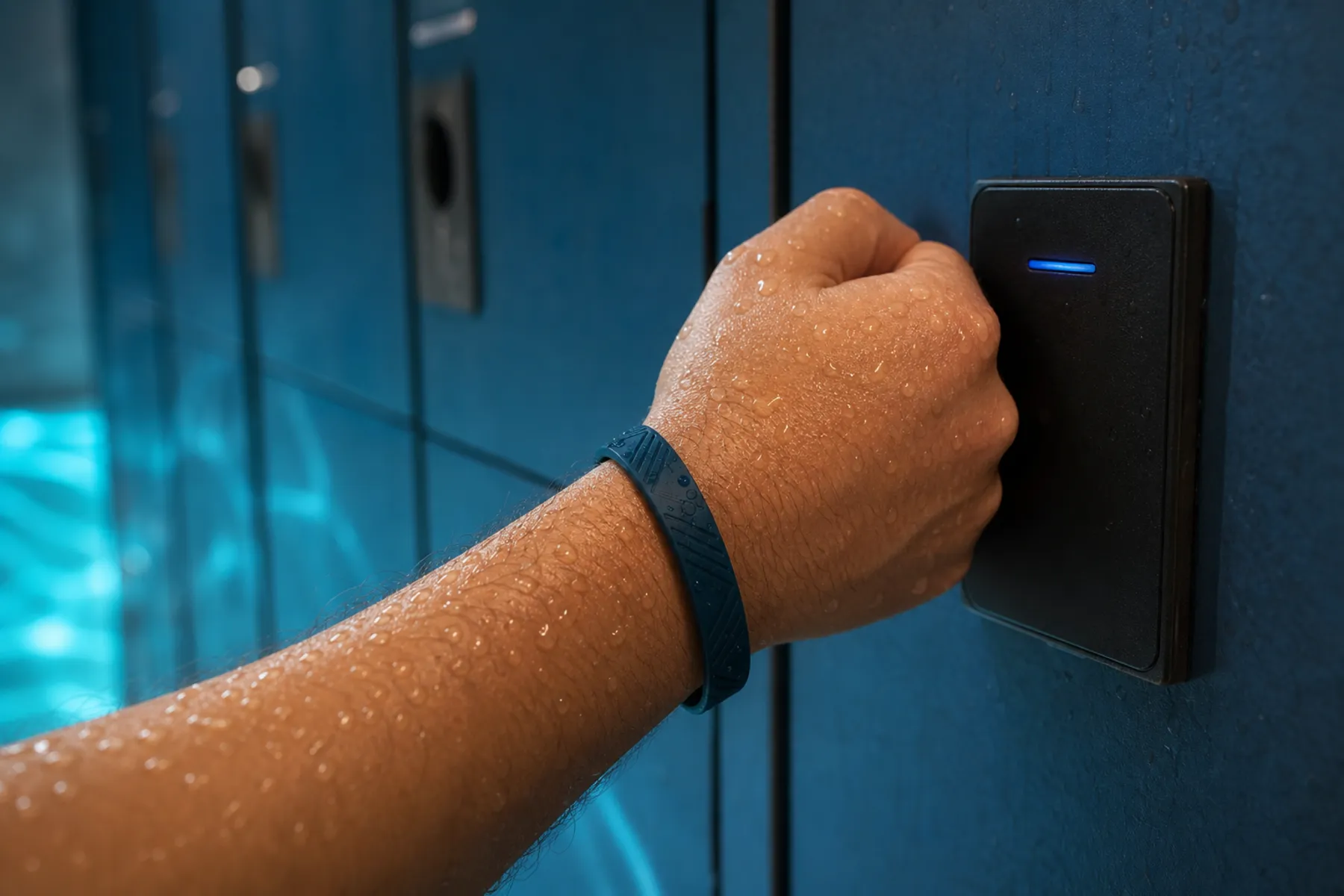
Sunscreen and body oils
Structurally irrelevant and cosmetically decisive. They build a film that dulls printed marks and collects in debossed recesses, and they make closures slippery to operate — a small repeated annoyance in a wet-room environment.
The specification answer is a debossed or filled-deboss mark wherever the artwork has to survive a full stay, because the geometry carries it rather than a surface layer.
Heat cycling is the underestimated one
A property running saunas, steam rooms and hot tubs puts a credential through more thermal cycling in a week than a hotel band sees in a season. Moulded constructions handle it; assemblies with adhesives and natural faces are less predictable.
Where heat experiences are in scope, they belong in the sample test explicitly rather than being assumed to be covered by "water resistant".
Compatibility is confirmed against the property’s lock system, credential technology and encoding requirements before production. We do not claim universal compatibility.
Questions this raises
01Will chlorine wear out our wristbands?+
Not at pool concentrations, for moulded constructions. They fail mechanically — a forced closure, a lifted face edge — long before chemistry matters. Residue and dulling are cosmetic and mostly rinse away.
02Why do beach bands age faster than pool bands?+
Salt does its damage as the band dries: crystals stiffen cords and abrade fibres from inside. A fresh-water rinse after sea swimming is the whole mitigation and it makes a season-long difference.
03Do we need to worry about sauna use?+
Yes, more than about the pool. Repeated heat cycling is harder on any assembly than immersion is, and it is the exposure most often left out of a sample test. If heat experiences are in scope, test for them explicitly.