Two populations, one gate
The resident has already paid, at the hotel, and expects to walk in. The day guest has paid at the door for a defined window. The staff member at the gate has three seconds and a queue. Everything else is detail.
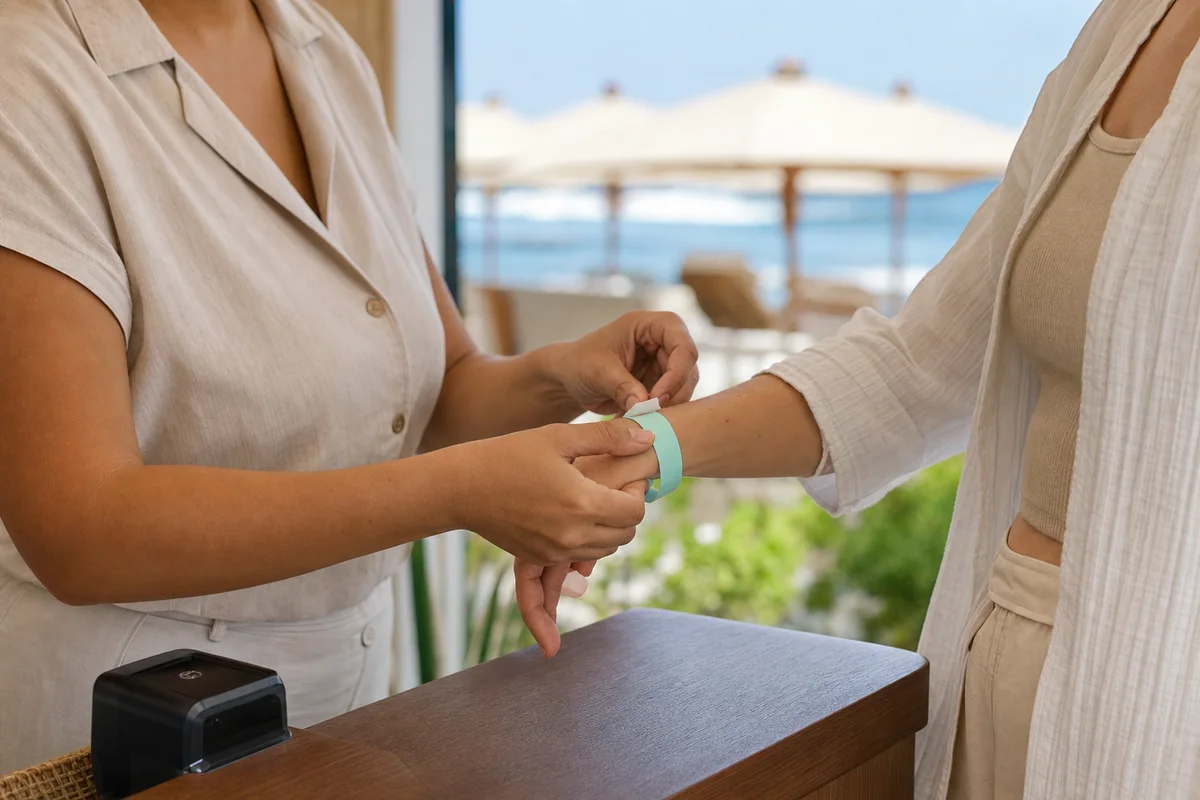
That argues for two visually distinct credentials rather than one credential with two states. A resident band and a day band that differ in colour and in construction can be told apart peripherally, while a single band with a printed tier marker requires a member of staff to actually read something, which is what a queue does not allow.
Time-bounded access needs to be visible, not just enforced
A system can expire a credential at 18:00. It cannot tell a member of staff at 18:30, across a terrace, that the guest at the bar bought a morning session. Where sessions matter, the band has to show it — a colour per session, or a printed time on a desk-printed band.
The strongest pattern we see is colour by day combined with a printed session on the band itself: the colour stops yesterday’s band being used today, and the print resolves any question about which session was bought.
A day-colour system only works if a regular visitor cannot predict tomorrow’s colour. Agree the full palette up front and rotate it out of sequence.
Transfer is the actual risk
The loss a beach club takes is not theft of a wristband; it is one paid admission worn by two people across an afternoon, handed over at the beach exit. An adjustable closure makes that effortless and invisible.
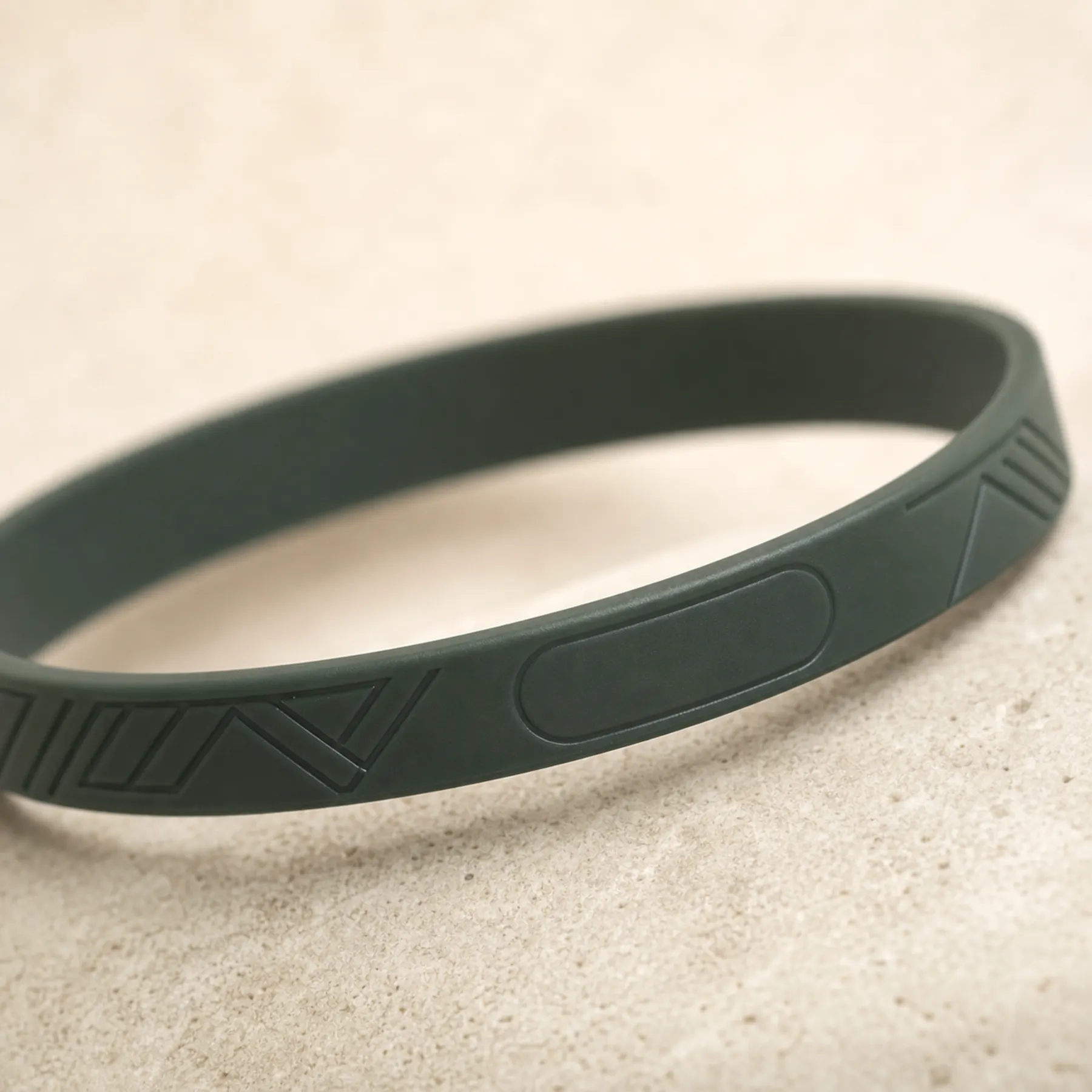
For the paid population that means a one-way closure, accepting that every band is consumed on issue and that fitting is final. For residents it does not — they are already inside the property’s system, and a comfortable reusable band is the better guest experience.
Sun and salt, not just water
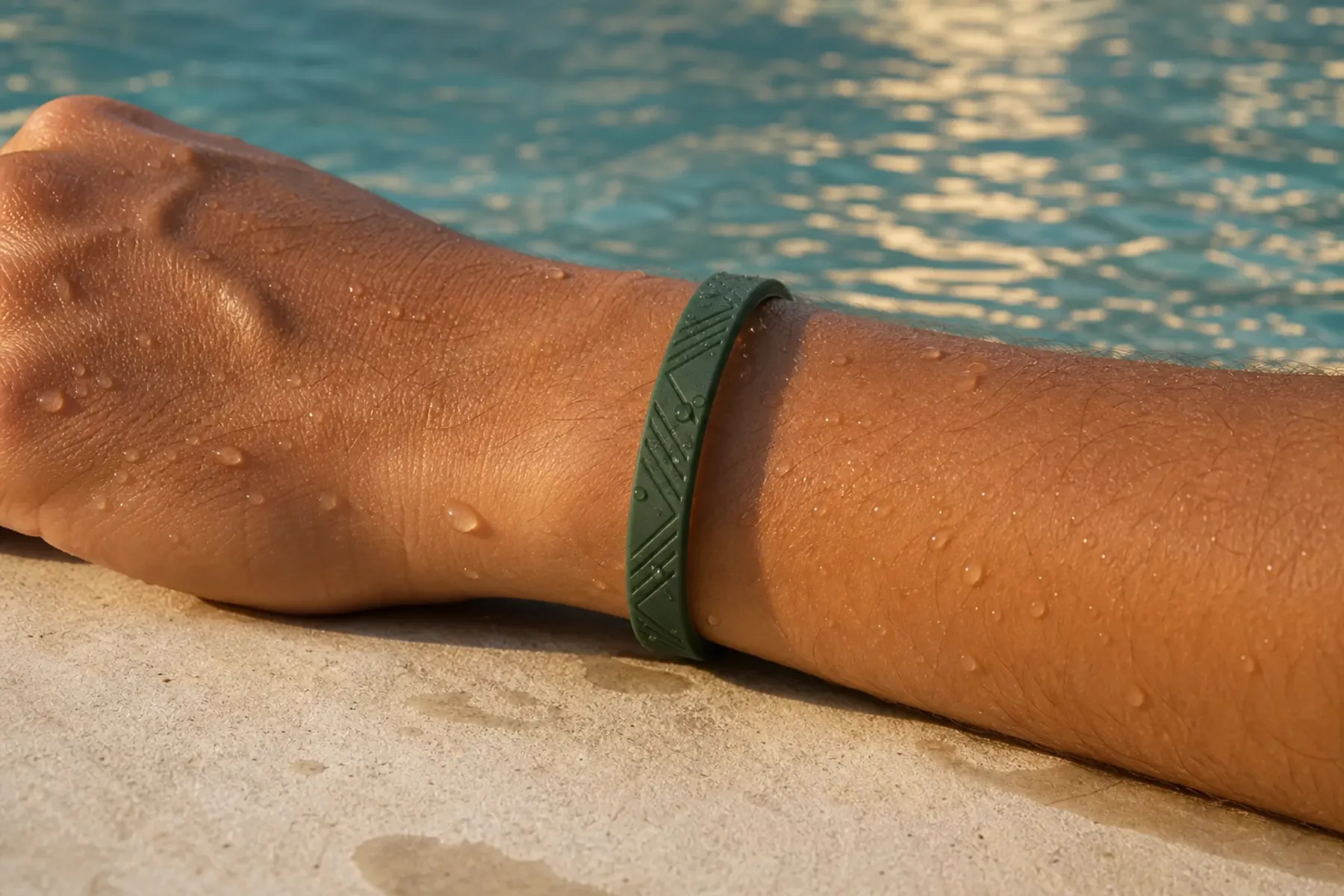
A beach club is a harsher environment than a pool. Salt crystallises as things dry, sand abrades, and UV is direct and sustained for the whole operating day. Materials that are fine in a hotel pool age visibly here: pale pigments shift, cords stiffen, printed surfaces dull.
The specification consequences are concrete: choose colours that stay separable at the end of a season, prefer debossed marks over printed ones on anything reused, and avoid metal fittings entirely — a corroded fitting on a beach band stains the strap and eventually seizes.
Lockers, towels and cashless as the real use
Most beach clubs are not really running door access — they are running lockers, towel issue and a bar tab. Those readers are outdoors, sometimes on metal structures, often in bright sun where a guest cannot see an indicator light, and always presented by someone with wet hands and one arm full.
That combination is worth testing explicitly on a sample. A credential that reads instantly at the entrance desk and hesitates at the locker bank will be judged on the locker bank.
The end of the day
Day bands come off, and where they come off is a choice. If the property does nothing, they end up in the sand and in the bar bins. A cutting station and a bin at the exit is a small intervention that keeps the site clean and keeps used credentials from being picked up and re-presented.
For resident bands the question is whether they are recovered at all — most properties leave them with the guest for the length of the stay, which means the beach club is issuing nothing to residents beyond the first day.
Planning a season
Day admissions are the volatile number: they follow weather, cruise calls and local events. Under-ordering means a Saturday with no bands; over-ordering means a colour that cannot be used next season if the palette rotates.
The pattern that works is a generic resident band ordered once for the season and day bands ordered per colour with a deliberate reserve, with minimum order at 500 pieces per artwork and 14–21 days production after artwork approval built into the calendar rather than discovered in July.