Suppliers describe wristbands as water-resistant. That phrase covers everything from a band that survives a rain shower to one that lives in a chlorinated pool for a season, so here is how to test the difference yourself before you commit to a run.
Test the finished band, not the material
Silicone is unaffected by pool water. That fact tells you nothing useful about a finished wristband, because bands do not fail through their material — they fail at closures, at the joint between a face and a strap, at a weld, or at a seam around a module.
So the sample you test has to be the production construction, with the real closure and the real module, not a material swatch or a hand-made mock-up. Testing anything else produces a result that will not repeat.
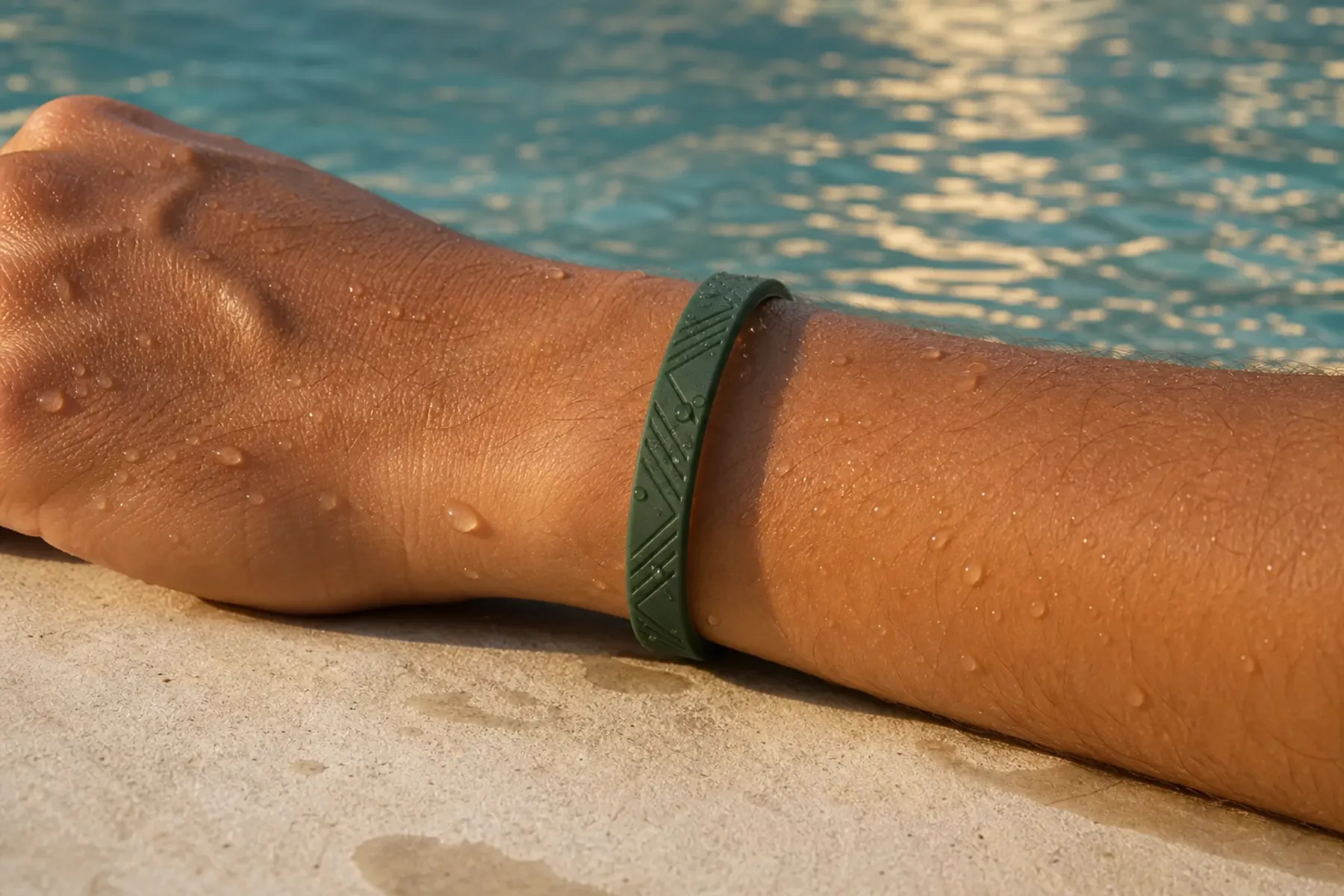
Reproduce a guest, not a laboratory
A guest applies sunscreen, gets into a pool, dries in the sun, showers, sleeps, and does it again for a week. That cycling is the test — not immersion alone. Sunscreen and body oils build up in recesses, salt crystallises as bands dry, and repeated wet-and-dry does more to a closure than continuous immersion does.
A simple protocol most properties can run in-house: wear the sample for a full week under real conditions, on a member of staff who uses the facilities, and inspect it daily against a written list rather than by impression.
What to inspect each day:
- Closure: any elongation at the hole, any deformation at the post or clip
- Face shoulder: any lifting or separation where the face meets the strap
- Surface: how the mark reads after sunscreen, and whether it is dulling
- Read: present it wet, one-handed, at the locker and door readers you actually use
- Comfort: whether the wearer wants to take it off, and when
Read behaviour when wet is the test most people skip
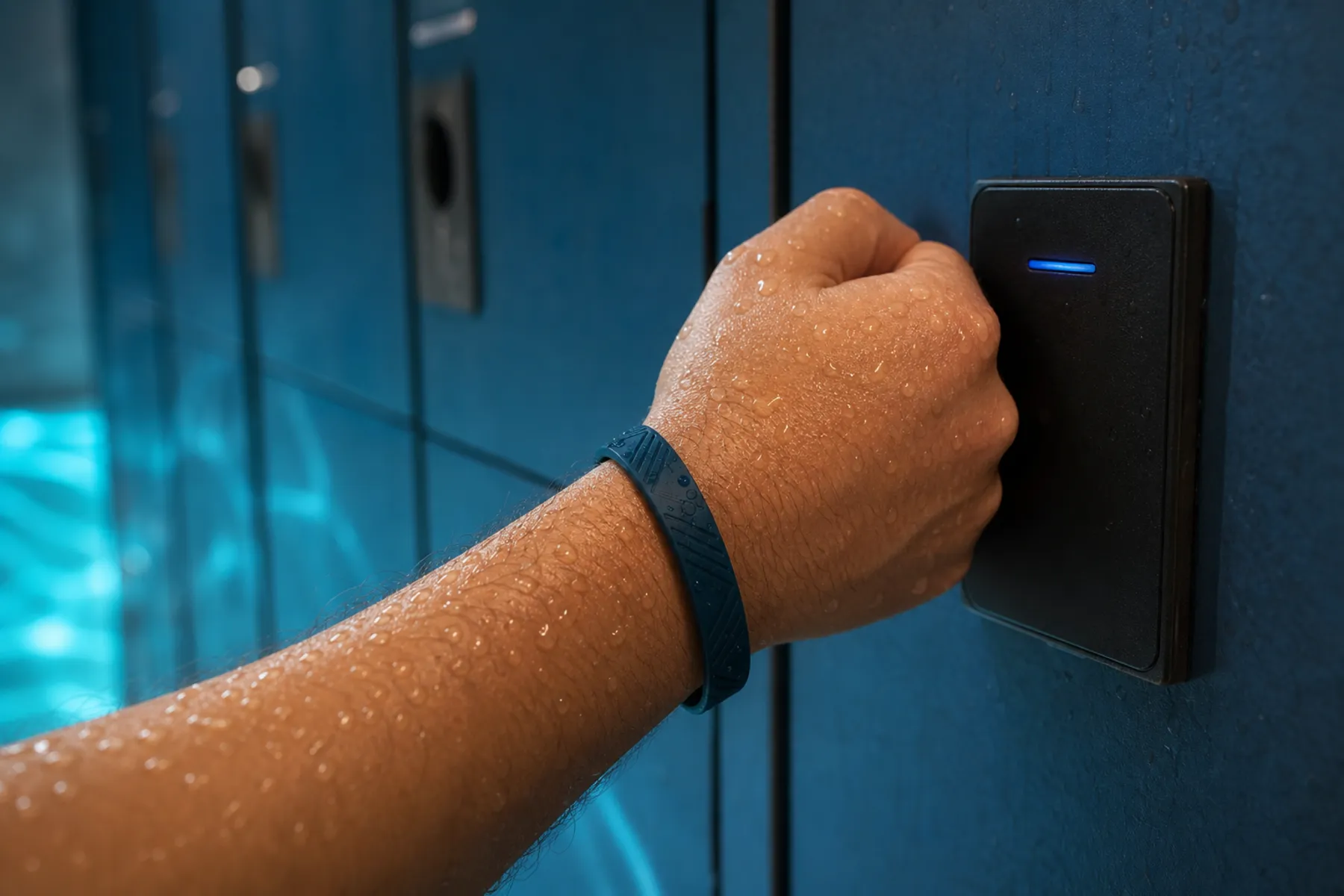
Water on and around a credential changes its behaviour slightly, and a wrist behind it changes it again. Neither is dramatic, and both eat into the margin at readers that were already marginal — recessed units, readers on metal, outdoor readers in bright sun.
The honest test is the awkward one: a soaked band, presented quickly, by someone holding something in the other hand. If it works there, the specification is sound. If it works only at the reception desk, you have tested the reception desk.
Chlorine, salt and sunscreen do different things
Chlorine at operating concentrations does very little to a moulded band. Salt is more aggressive, and mostly not while wet — it is the crystallisation as the band dries that stiffens cords and abrades fibres. Sunscreen does nothing structural at all and is the main reason printed marks stop looking new.
That ranking matters when choosing what to test for. A pool property should concentrate on mechanical wear at the closure; a beach property should add salt cycling and a fresh-water rinse step; both should assume sunscreen and specify a debossed mark if the artwork has to survive.
Write down what passing looks like before you start
The most common failure in wristband testing is that nobody agreed the acceptance criteria, so the result is a conversation about impressions. Set them in advance: no closure elongation after seven days, mark legible at arm’s length, read successful on first presentation at every reader in scope, no lifting at the face shoulder.
Those criteria then become the specification. They are what a reorder is measured against, and what gives a property standing if a later run behaves differently.
A week on a real wrist with a daily written inspection tells you more than any laboratory figure, and it produces acceptance criteria you can hold a reorder to.
Compatibility is confirmed against the property’s lock system, credential technology and encoding requirements before production. We do not claim universal compatibility.
What to send with an enquiry
Include the installed system model, an existing credential sample where possible, quantity, expected wear period, guest types, controlled zones and artwork direction. For material-led options, state the evidence or production documentation your procurement team expects.
FSC-certified material options available with supporting production documentation.
No named hotel or customer project is used as proof. The reasoning behind that stance is set out on the about page.