The question is not which method looks best on approval day. It is which one still reads at the end of the wear period, on that material, in that environment.
- The methods, ranked by how they age
- Fine detail is the first casualty
- Match the method to the substrate
- Colour that has to mean something
- Approve on the production shape
The methods, ranked by how they age
Printing puts a layer on the surface: the finest detail, the widest colour range, the shortest life. Debossing presses the mark into the surface so it is carried by geometry; an infilled deboss adds colour into that recess. Laser engraving removes material to expose a darker layer beneath, which is the right method on wood and the wrong one on silicone. Moulded colour builds the mark from two compounds and cannot wear off at all.
A useful rule of thumb: worn for a day, print it; worn for a stay, deboss it; wood face, engrave it; colour that must never wear off, mould it.
- Screen print
- Finest detail, widest colour. Dulls with abrasion and sunscreen.
- Deboss
- Carried in the geometry. Survives cleaning and wear. Single tone.
- Deboss and infill
- Colour held in the recess rather than on the surface.
- Laser engraving
- Wood, bamboo, cork. Permanent. Not available on silicone.
- Moulded colour
- Cannot wear off. Fixed at set-up; a change is a new run.
Fine detail is the first casualty
Hairlines, small reversed type, tight registration between two colours and delicate serifs all survive a flat proof and fail on a curved, moving, wet surface read at an angle.
The adjustment is to set type slightly heavier than a brand guideline suggests and to simplify marks with fine internal detail. A mark that reads at arm’s length on a wet band at an angle is the actual requirement.
Match the method to the substrate
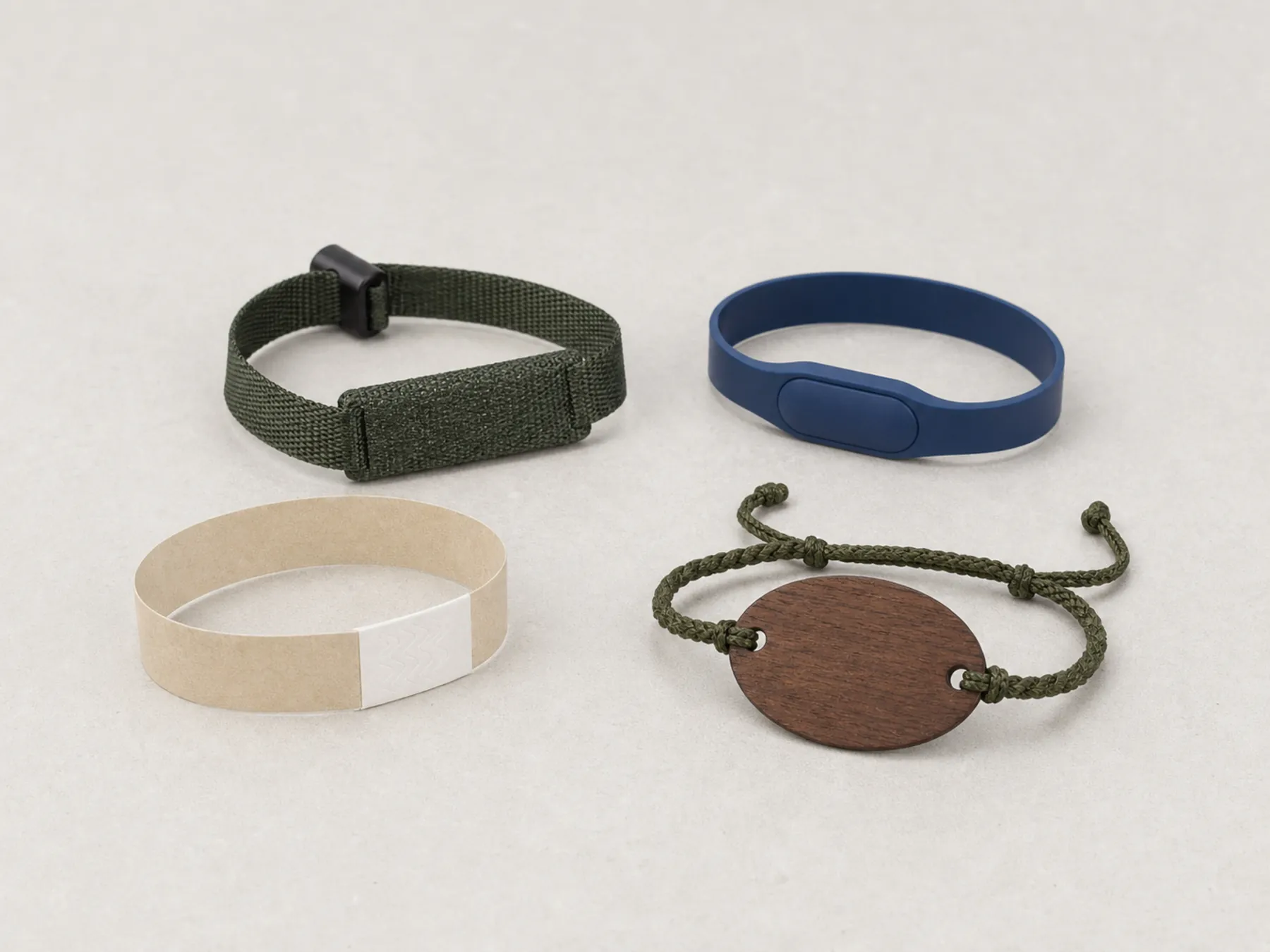
Silicone takes print, deboss, infill and moulded colour, and cannot be laser engraved usefully. Wood and cork take engraving and reject print, because a printed layer on a natural texture wears unevenly and undermines the material choice. Woven straps take jacquard weaving and dye sublimation, which differ in detail and durability the same way deboss and print do.
Forcing one identical treatment across four substrates makes the weakest one look like a mistake, which is why the same mark is usually rendered full on a card and simplified on a strap.
Colour that has to mean something
Wet silicone reads darker. Sun shifts pale pigments first. Recycled yarn takes dye slightly differently between batches. Where colour identifies a tier or a session, choose on hue contrast, check the palette wet as well as dry, and hold a physical reference for reorders rather than a colour name.
A palette agreed on a screen and approved on a dry sample will disappoint on a wet band at dusk, which is exactly when staff need to read it.
Approve on the production shape
A flat visual cannot show a logo sitting proud of a face radius, a mark falling into a closure shadow, or how ink behaves on a curve. Those appear only on the object, which is why artwork approval happens on a production-realistic sample.
The approved sample, artwork revision and colour reference are then held together as the reorder record, so a repeat run is measured against something physical rather than against a memory.
Compatibility is confirmed against the property’s lock system, credential technology and encoding requirements before production. We do not claim universal compatibility.
Questions this raises
01Print or deboss?+
Print for a credential worn for a day, deboss for one worn for a stay. A printed layer gives finer detail and dulls where sunscreen and handling collect; a deboss is carried in the geometry and survives cleaning, with an infill where a colour is needed.
02Can silicone be laser engraved?+
Not usefully. Engraving works by removing material to expose a darker layer, which is a wood and cork technique. On silicone the equivalent permanence comes from debossing or from moulded colour.
03Why does our logo look wrong on the woven strap?+
Because thread count resolves detail more coarsely than print or engraving. A mark that works on a card can look like an error woven at the same complexity — the pattern that works is a full mark where the surface supports it and a simplified device where it does not.