Most properties try to improve a credential programme by changing the material. The larger variable is almost always how many credentials you issue per guest per year — and that is an operating number you can measure this week.
Measure the throughput before changing the material
A durable credential recovered and reissued twenty times displaces twenty single-use ones. No substrate choice available anywhere comes close to that ratio, which means recovery rate is the dominant term and material is a secondary one.
The number is easy to establish and rarely known: credentials issued in a season, divided by guests. Properties are routinely surprised by it, usually because reissues for loss and day-visitor credentials are counted nowhere.
The four numbers that describe a credential programme:
- Credentials issued per guest per stay, including replacements for loss
- Recovery rate at checkout — measured over a week, not estimated
- Cycles survived by a recovered credential before retirement
- Share of total issue that is single-use day credentials
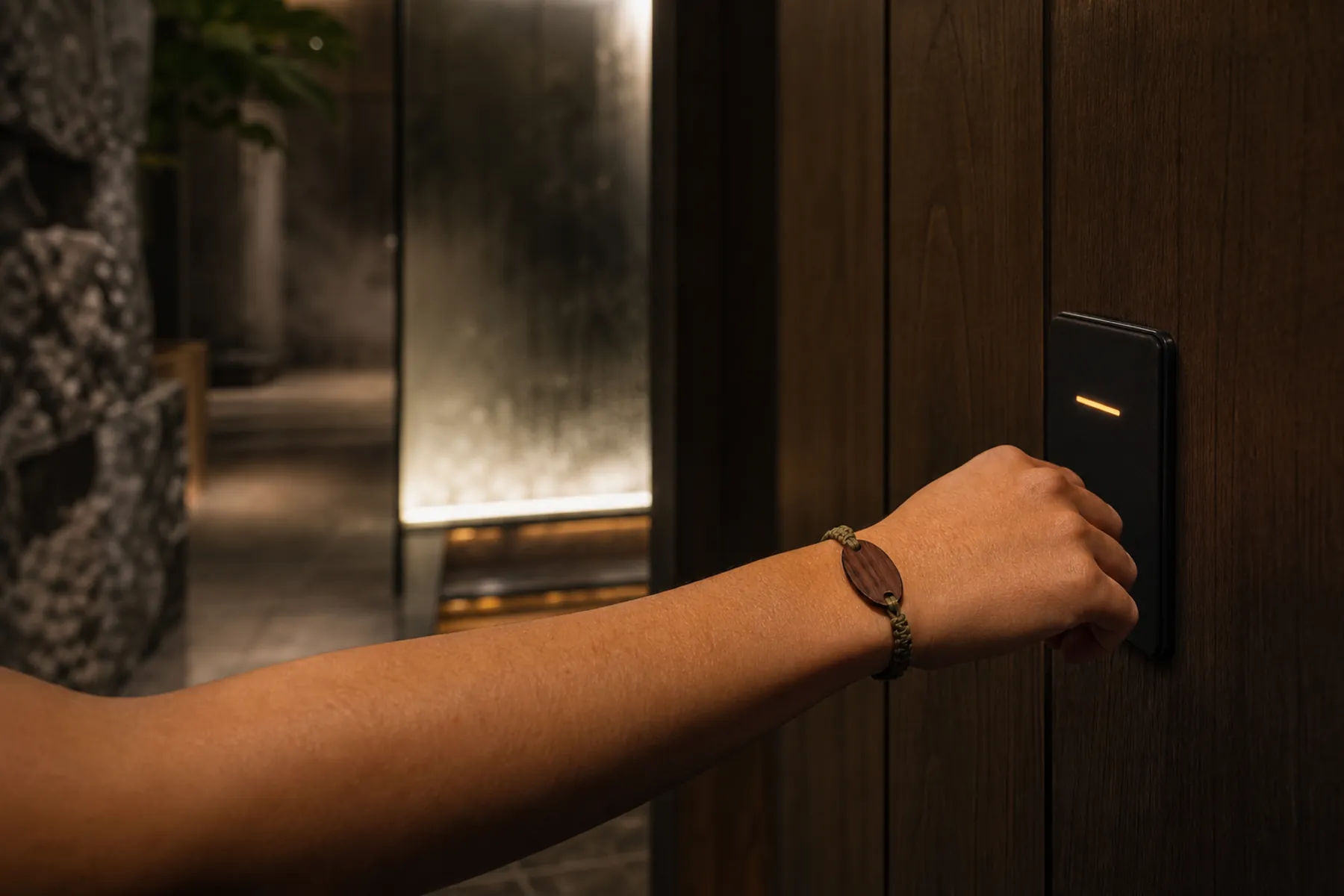
Recovery is a design problem, not a willpower problem
Properties that recover credentials well do three things: they make surrender part of an existing checkout step rather than an extra one, they give housekeeping a defined route for what they find, and they hold enough stock that no one is ever tempted to reissue an unclean band.
Properties that recover badly usually have no route for found credentials, which is also a security issue — a drawer of enabled bands is a set of live keys nobody is tracking.
Where a material change genuinely helps
It helps where the credential is unavoidably single-use: day admissions, events, visitor passes. Those are the credentials that cannot be recovered, so the substrate is the only variable available, and choosing a lower-impact carrier there is a real decision rather than a cosmetic one.
It helps far less on the resident band, where the same object could simply be used again. Changing the material of a credential you already reuse is the smaller of two available improvements.

Do not let the claim outgrow the evidence
A reduced issue rate is a measurable operating fact and a strong thing to publish. A material description supported at run level is another. What does not survive contact with a well-informed guest is a claim about the finished credential, because every credential here contains a sealed electronic module.
The strongest position we see properties take is arithmetic: this many credentials issued last season, this many this season, and this is what changed. It is specific, it is verifiable internally, and nobody has to take a material claim on trust.
“We issued 40 per cent fewer credentials than last season, and here is what we changed” is stronger than any material statement — and it is a number you already have the means to produce.
What we can supply toward it
Material declarations at run level, constructions specified for recovery and cleaning rather than for single use, and a reorder record that keeps a repeat run identical to the approved one.
What we will not supply is wording that turns one component into a property of the whole product, or a comparative claim about other materials that we cannot evidence.
Compatibility is confirmed against the property’s lock system, credential technology and encoding requirements before production. We do not claim universal compatibility.
What to send with an enquiry
Include the installed system model, an existing credential sample where possible, quantity, expected wear period, guest types, controlled zones and artwork direction. For material-led options, state the evidence or production documentation your procurement team expects.
FSC-certified material options available with supporting production documentation.
No named hotel or customer project is used as proof. The reasoning behind that stance is set out on the about page.