A property that orders a multi-year stock horizon is also buying a multi-year storage problem, and most of the failures we see in held stock were created by the store room rather than by the product.
- Counted, range-labelled blocks
- Store flat, not compressed
- Sealed storage in humid and salt environments
- Heat and light
- Check before a peak, not during it
Counted, range-labelled blocks
Goods packed in counted blocks with the range on the label let a property record what arrived without opening everything, and let an issue point reconcile by block rather than by scanning — which still works when a network does not.
It also contains problems. An issue traced to a labelled range is a contained finding; the same issue in an unlabelled delivery is a question about the whole delivery.
Counted blocks with ranges on the label cost nothing and cannot be added after production. It is the cheapest improvement available in a credential programme.

Store flat, not compressed
Vinyl and welded constructions develop creases where they are folded or compressed in storage, and a crease at a weld line eventually delaminates. Cards stored under weight bend and can break an antenna connection.
Storing flat or loosely coiled costs nothing and materially increases how many cycles a recovered band survives. It is the single most useful storage instruction for any welded or laminated product.
Sealed storage in humid and salt environments
Stock held for months in a humid climate is being conditioned whether or not it is being used: natural fibres take up moisture, adhesives soften, and compostable carriers begin the process they were designed for. In salt air, metal fittings corrode and cords stiffen in the box.
Sealed storage answers all of that, and it should be written into the goods-in procedure rather than assumed. Stock held through a wet season should be opened and checked rather than trusted.
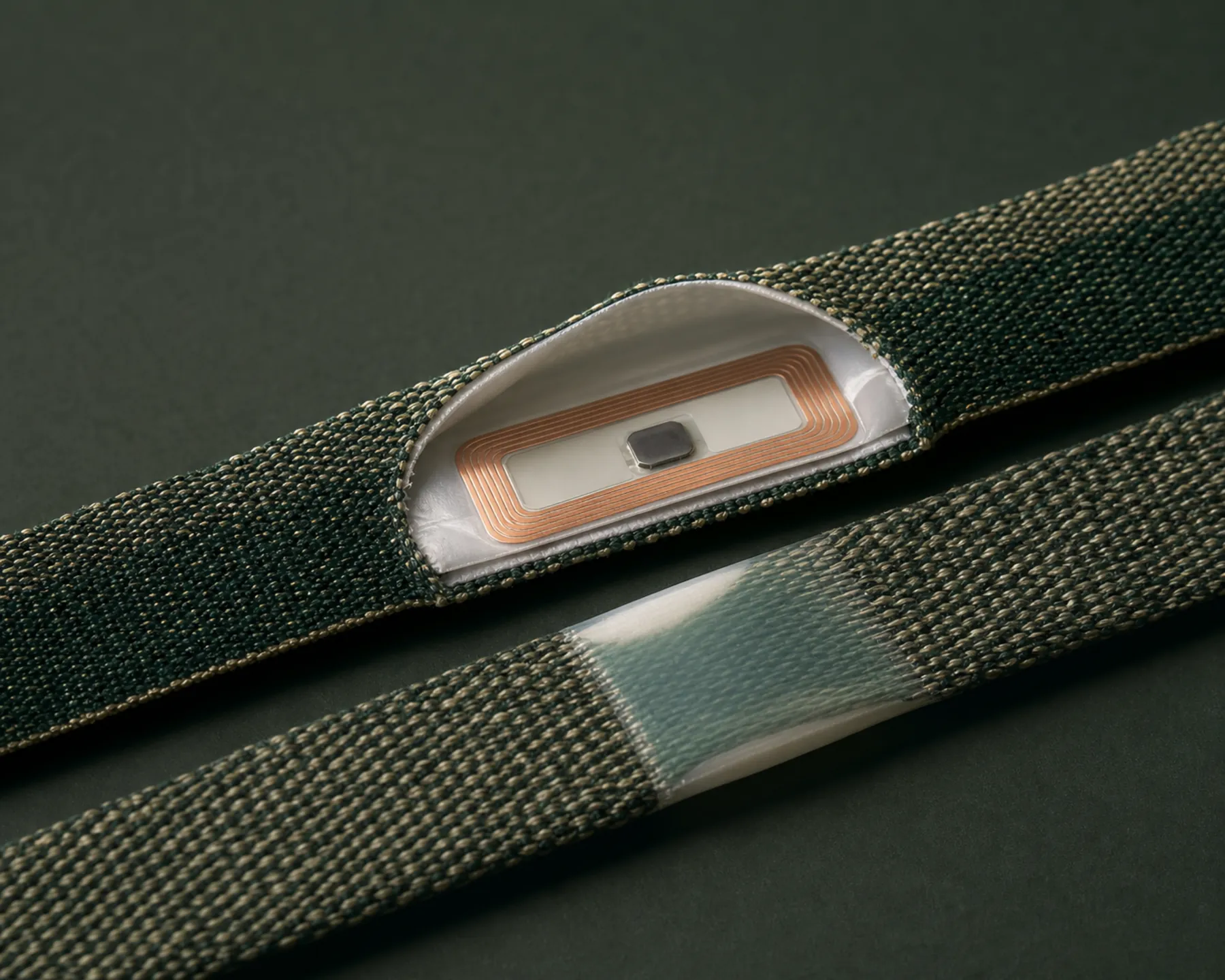
Heat and light
Direct-thermal printed credentials stay heat-sensitive after printing, so stock and issued bands both darken in heat and sun. Any adhesive closure behaves differently after a summer in an unconditioned store room.
Where a property has no conditioned storage, that is an argument for ordering closer to use and holding less — a trade against the supply interval, and worth making deliberately.
Check before a peak, not during it
Open a block from any stock held through a season change and present a credential at a real reader before the peak begins. Five minutes, and it catches anything the sealed box was supposed to prevent.
That is also the moment to confirm the ranges against the paperwork, so the audit position is current before the busy period rather than reconstructed afterwards.
Compatibility is confirmed against the property’s lock system, credential technology and encoding requirements before production. We do not claim universal compatibility.
Questions this raises
01How should credentials be packed?+
In counted blocks with the range printed on the label. It lets goods-in record what arrived without opening everything, lets an issue point reconcile without a network, and contains any later problem to a specific range.
02Does stock degrade in storage?+
It can. Humidity conditions natural fibres and softens adhesives, salt air corrodes fittings and stiffens cords, and heat darkens direct-thermal printed stock. Sealed, flat, conditioned storage answers almost all of it.
03What should we check before a busy season?+
Open a block from anything held through a season change, present a credential at a real reader, and confirm the ranges against the paperwork. Five minutes before the peak beats reconstructing it afterwards.