What a one-way closure is really controlling
The risk in a paid-admission zone is not that a guest loses a band. It is that one paid admission is worn by three people over an afternoon. A closure that reopens makes that trivially easy; a closure that has to be cut makes it visible and destructive, which is enough to change behaviour.
That is why the band is specified as a single-stay or single-event credential rather than a reusable one. A property that wants both security and reuse is asking for two incompatible things from one closure, and should run a reusable band with a system-side control instead.
How the closure is built
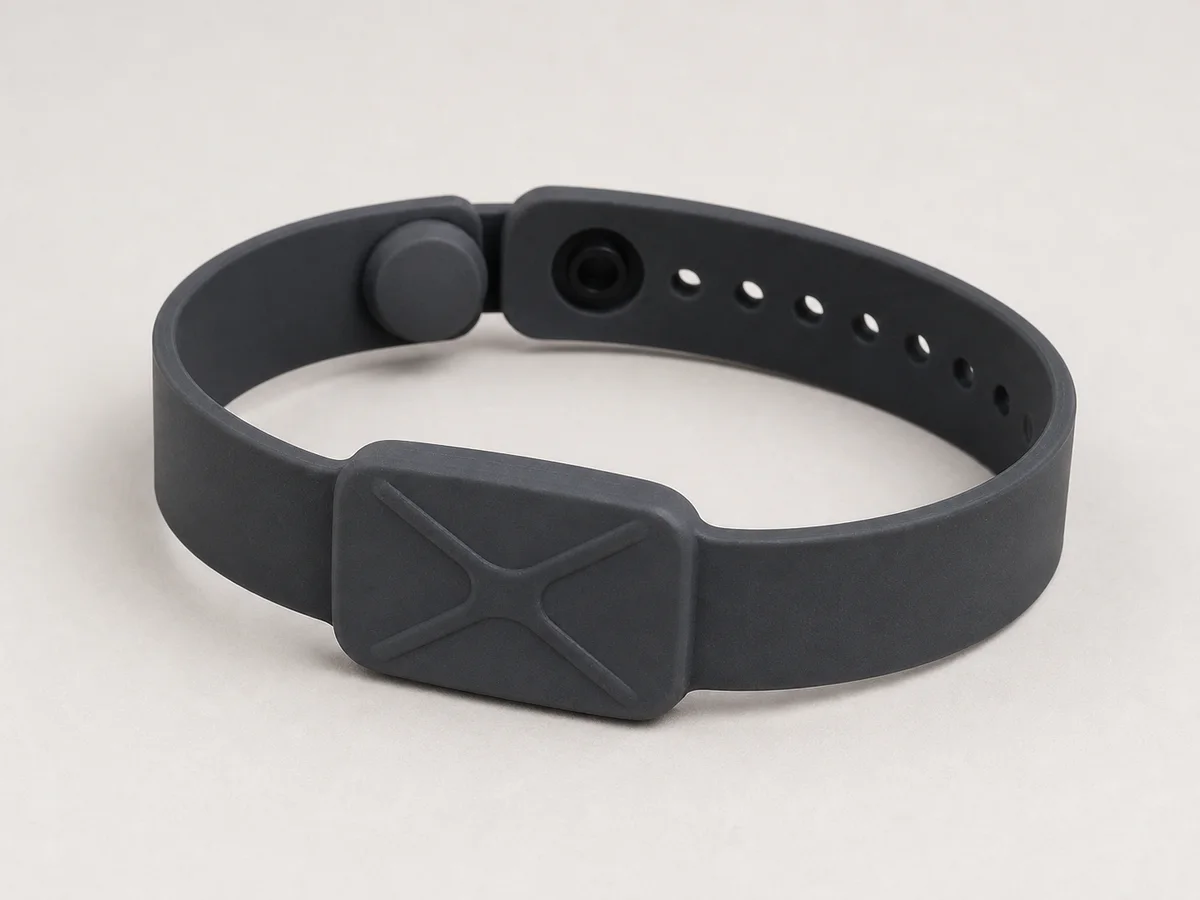
The locking geometry engages inside the strap rather than presenting an external catch, so there is no lip for a guest to lever. Working it loose leaves marks around the closure, which gives staff something to look for during a spot check — tamper evidence is only useful if a member of staff can recognise it in two seconds without training.
The reinforced section matters as much as the lock. A band that cannot be unclipped but can be stretched over the hand has not controlled anything, so the strap resists elongation as well as the closure resists reopening.
Fitting it correctly at issue
This is the model where fitting is a procedure, not a courtesy. Too loose and the band can be worked over the hand, which defeats it; too tight and the property has created a comfort problem it cannot fix without destroying a credential and issuing another one.
We recommend that staff fit the band on the guest rather than handing it over, and that the property agrees in advance what happens when a fit is wrong — because it will be, and the answer “cut it and issue a new one” has a cost that should be in the quantity plan rather than a surprise.
Minimum order is 500 pieces per artwork, with 14–21 days production after artwork approval. A one-way band consumes stock on every misfit, so the order should carry an explicit allowance for refits rather than matching the admission count exactly.
Removal, waste and the guest conversation
Removal requires a tool. That should be at every exit point where guests are expected to leave the zone permanently, not just at a central desk, or guests will remove bands themselves in ways that are messier and occasionally unsafe.
It also creates a waste stream the property has chosen deliberately: every credential issued is a credential destroyed. That is a defensible trade for genuine access control, but it should be an explicit decision, and it is the main reason we do not recommend this model as a general-purpose resort band.
What it does and does not prove
A one-way band proves that this physical credential has not been unfastened. It does not prove who is wearing it, and it does not prevent a guest from handing the whole band over after cutting it if the property does not also check the closure. The physical control and the staff procedure work together or not at all.
On the system side, the credential still needs the same confirmation as any other: technology, encoding and reader behaviour are established against the installed system before production, and the tamper property adds nothing to that.
When this is the wrong model
It is wrong as a hotel room credential for a normal stay. Guests expect to remove a band, and a credential that cannot be removed for a week generates complaints that outweigh any access benefit.
It is wrong for children, where a band that cannot be removed quickly is a poor idea regardless of the access argument. And it is wrong for any property that intends to recover and reuse bands, because reuse and one-way closure are mutually exclusive by design.