Why rope rather than a woven cord
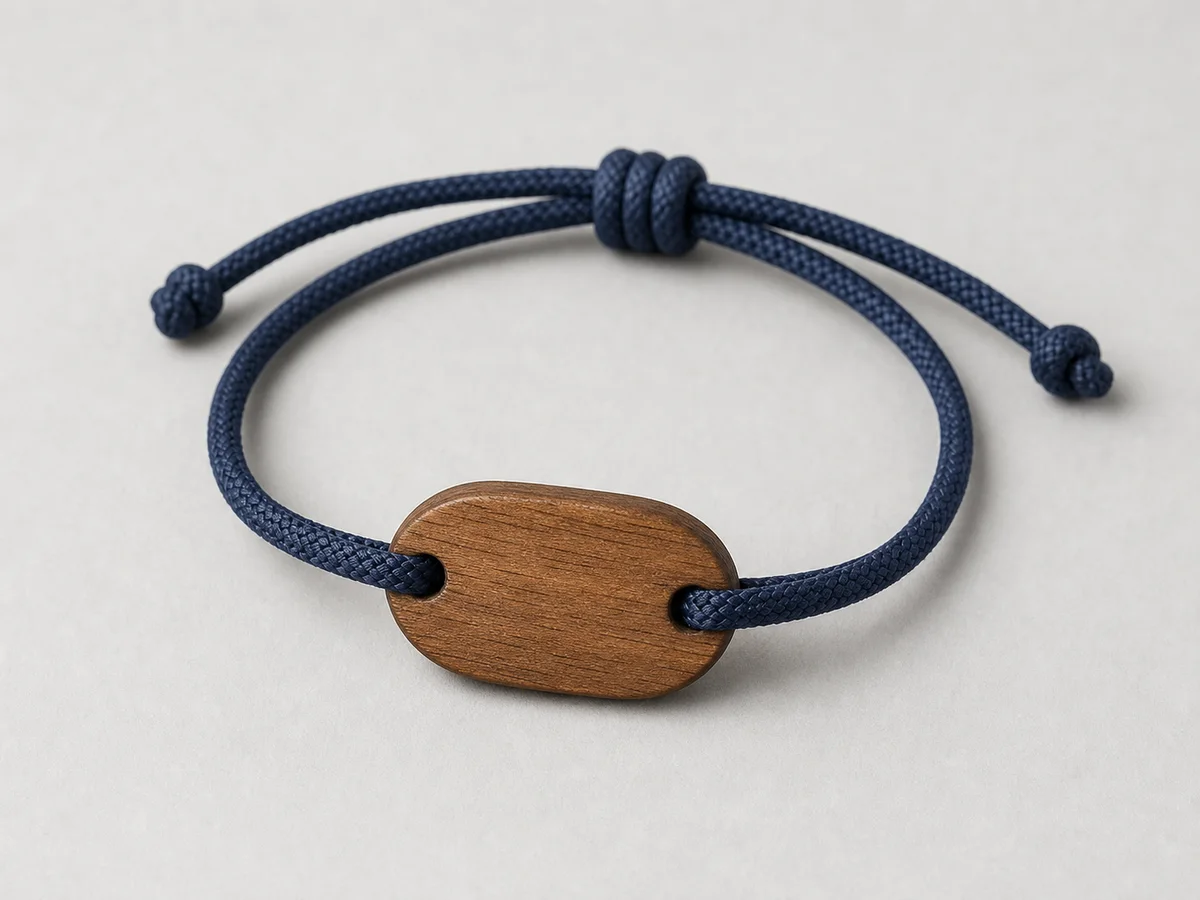
A flat woven cord sits neatly and behaves badly at the beach: it holds sand in the weave, wicks salt water along its length and stays damp against the skin. A braided rope sheds sand, dries from the outside in and does not trap grit against the wrist in the same way.
Rope also fails visibly. It fluffs and softens over weeks before it ever loses strength, so a band that is reaching the end of its life announces it, which is far preferable to a closure that lets go without warning.
Salt is the environment, not water
Fresh water leaves rope unchanged. Salt water leaves salt, and as it dries the crystals stiffen the braid and abrade the fibres from the inside — which is why a beach band ages faster than a pool band even though the pool band is wetter more often.
A rinse in fresh water is the entire maintenance regime, and it is worth telling guests once. For property-owned bands that are recovered, a rinse step before storage does more for the life of the stock than any material upgrade.
Rinse in fresh water after sea swimming. It is the difference between a band that stays supple for a season and one that stiffens in a fortnight, and it costs the property nothing.
The sliding knot, and what removing metal buys
An adjustable sliding knot has no clip, no buckle and no metal fitting, which matters at the coast: any metal component in a salt environment is a corrosion timer, and a corroded fitting stains a strap and eventually seizes.
The knot adjusts continuously and holds under normal wear, but it can be worked loose by deliberate fiddling. That makes it unsuitable for controlled-access use, and entirely suitable for a resident guest at a beach club where the credential is a convenience rather than a gate.
The face, the sun and the sand
A sealed wood face handles salt spray well and handles sun less well: prolonged UV lightens exposed wood over a season, and it does so unevenly because the band rotates. A mid-tone face ages more gracefully than a very dark one, where the lightening shows as a contrast shift.
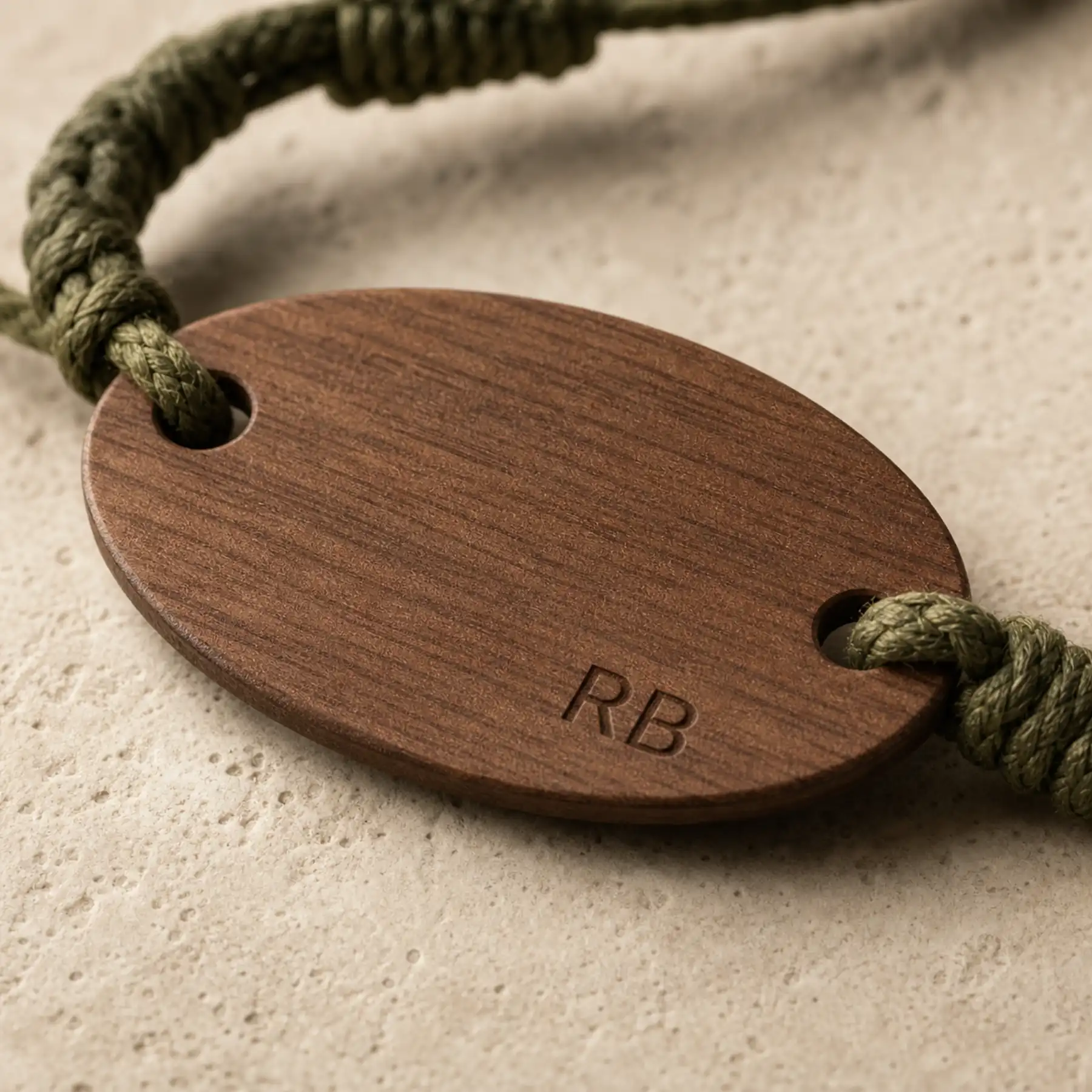
Sand is abrasive against a finish, so the surface dulls at the edges first. An engraved mark keeps reading through that because the mark is cut, not applied, which is the same argument as everywhere else in this catalogue and is most visible here.
Read behaviour at a beach club
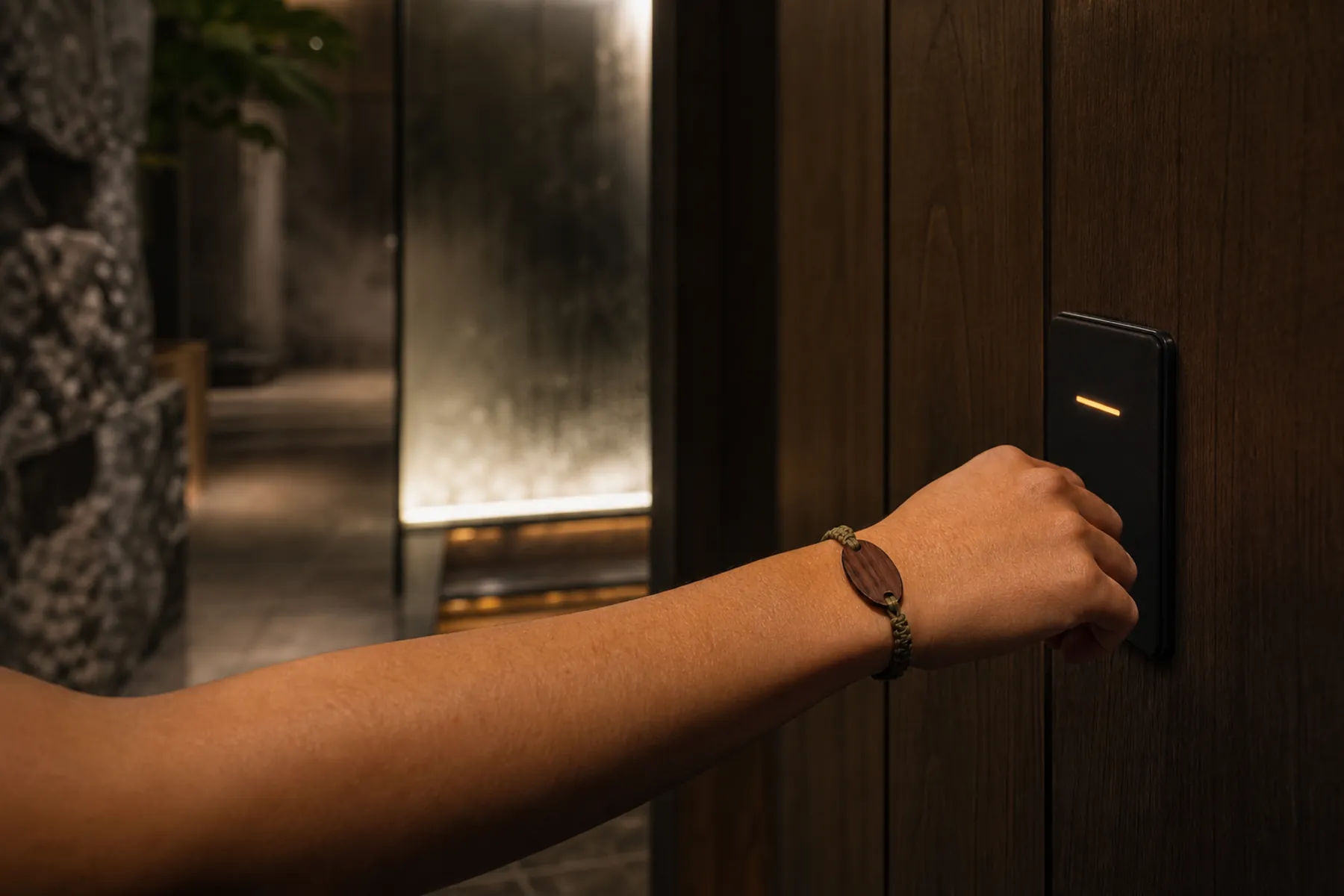
The credential sits behind the face, and neither the wood nor the rope interferes with a high-frequency credential. What changes at a beach club is where readers are: often outdoors, sometimes on metal posts or bar structures, occasionally in bright direct sun where a guest cannot see an indicator light.
That makes reader-side testing more important than usual. We present a production-realistic sample at the actual readers, including outdoor and metal-mounted ones, before a run is approved.
When this is the wrong model
It is wrong for controlled or paid access, because a sliding knot can be worked loose and the band passed on. It is wrong for children, and wrong at high-volume issue points where a knot takes too long to fit.
It is also wrong indoors. Everything that makes this construction right at a beach club — the rope, the knot, the weathering face — reads as costume in a city hotel.