What “slim” costs and what it buys
Every millimetre taken off the strap width takes something off the artwork panel and off the closure’s tear resistance, and gives back comfort. That trade is worth making for a property whose guests wear the band at dinner, and not worth making for a water park where the band is pulled at all day.
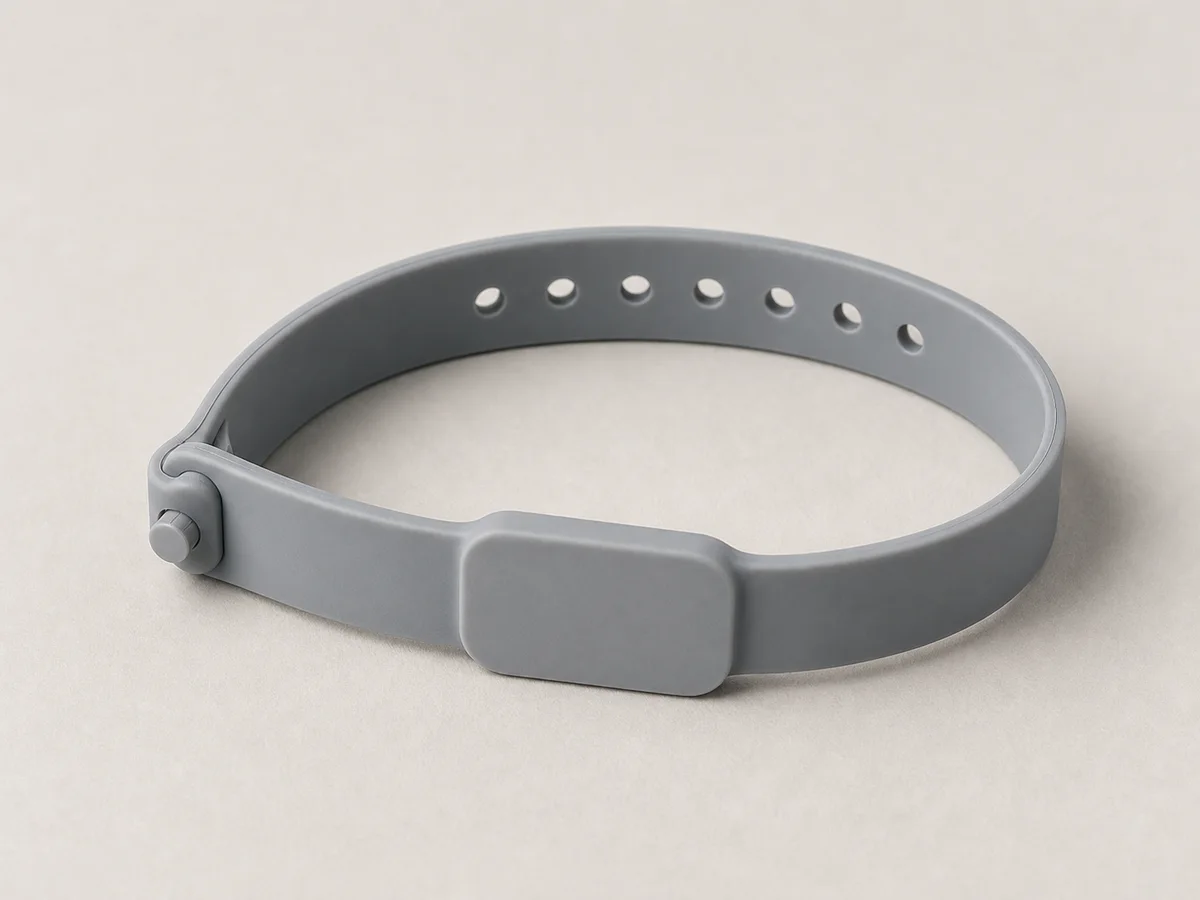
The lower limit is set by the credential, not by taste. The module has to house an antenna large enough to work at the property’s readers, so a band cannot be narrowed indefinitely without changing the read behaviour. We size the strap to the module we have confirmed, rather than choosing a width first and hoping the electronics fit.
Comfort over a seven-night stay
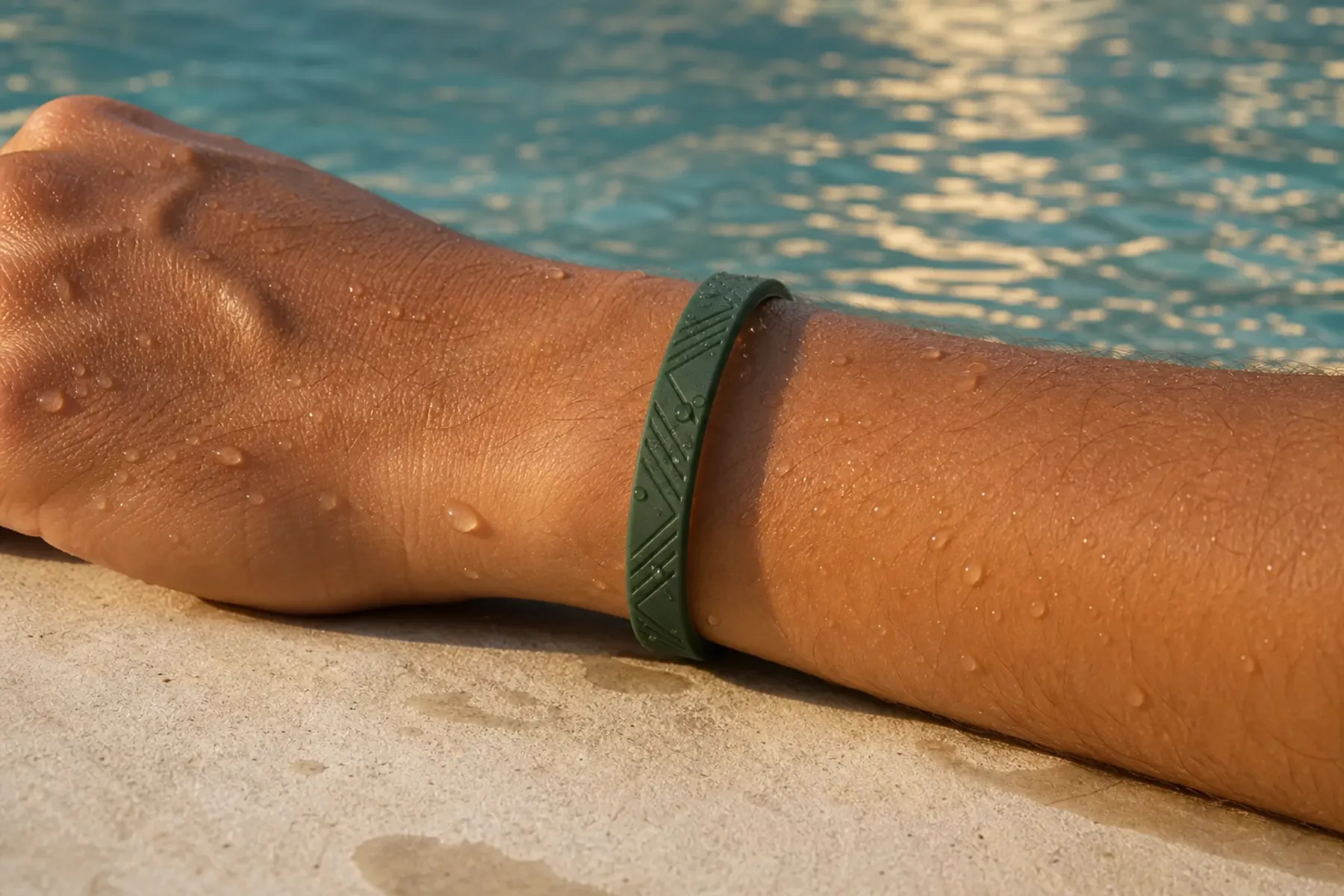
The complaint that ends a wristband programme is rarely “it broke”. It is that guests took it off. A narrow band with a low module sits under a watch strap, does not catch on a sleeve and stops being noticed by the second day, which is the behaviour a property needs if the band is carrying room access.
Where the band is worn continuously, the underside finish matters more than the top surface. A smooth underside without a moulding witness line under the module is what stops the small persistent irritation that makes a guest remove it in the evening and leave it in the room.
Artwork within a small panel
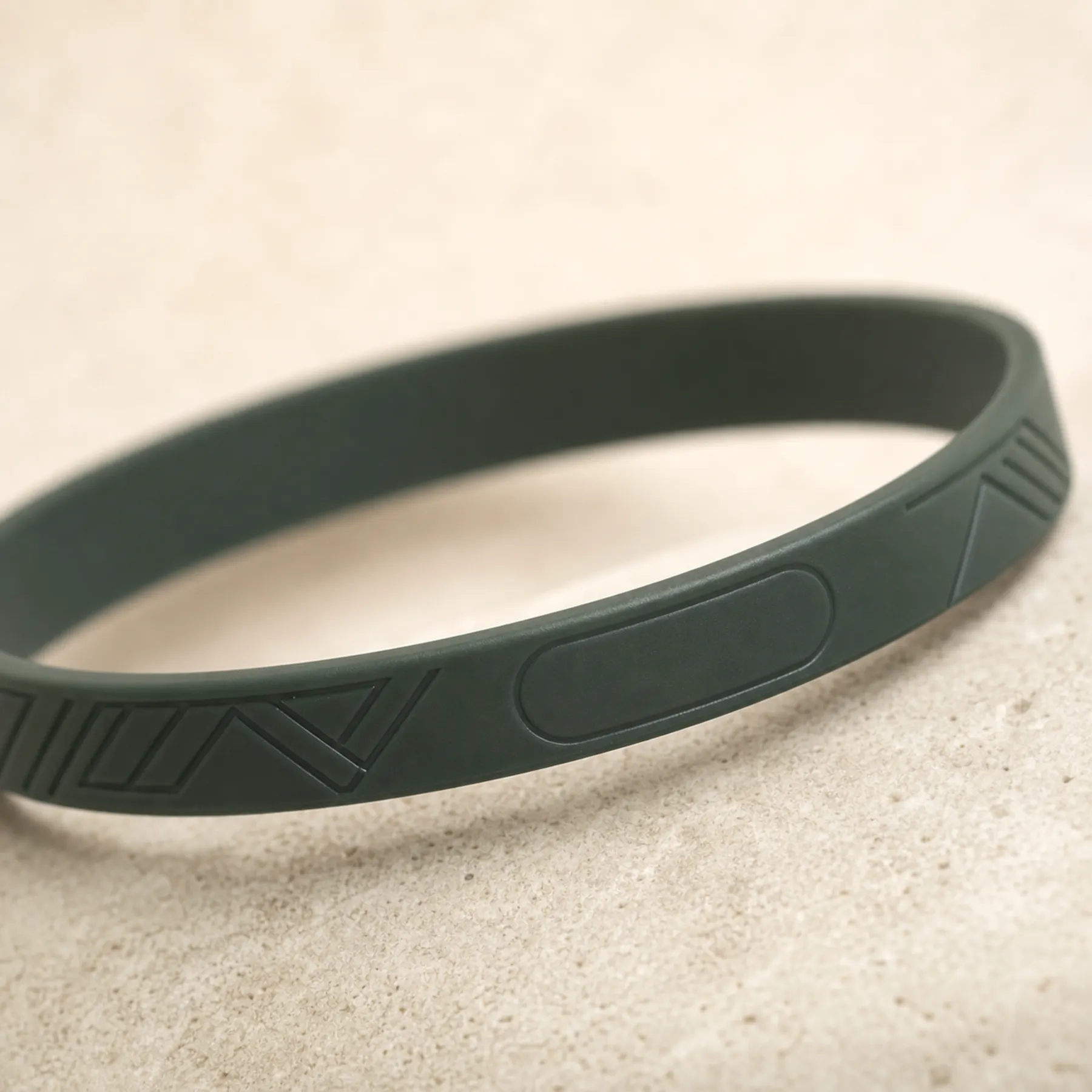
On a narrow band, a printed logo has to be small enough to fit and therefore fine enough to blur when the surface flexes. A deboss avoids that: the mark is cut into the surface, so it stays legible as the band moves and does not dull under sunscreen. An infilled deboss adds a colour without adding a printed layer that can wear.
A repeated mark along the strap often works better here than one mark on the face. It keeps the property visible when the band has rotated, and it turns a small panel problem into a rhythm that suits the band’s proportions.
Water and daily wear
Water is not the issue for silicone; the closure is. A narrow closure has less material around the post hole, so forcing the post into a hole at an angle — which is what a guest in a hurry does — is more likely to start a tear here than on a thick band. Demonstrating the closure at issue is a genuine mitigation, not a formality.
Sunscreen and body oils build up faster in a deboss than on a flat surface, which is the small maintenance cost of choosing deboss over print. A rinse restores it; nothing else is needed.
Issue and reorder
The band is issued adjusted, and adults do not usually need to change it after the first fit. That makes it well suited to a property that wants a low-touch credential: fit once at check-in, forget it, recover or release at checkout.
For reorders, the approved sample, artwork revision, colour reference and the confirmed credential input travel together as one reference. Changing the module — even to something nominally equivalent — is a change to the read behaviour and to the fit, so it triggers a fresh sample rather than a repeat.
Minimum order is 500 pieces per artwork, with 14–21 days production after artwork approval. On a slim band, a colour change is a new artwork count; a size change within the adult range is not.
When this is the wrong model
It is the wrong choice for a water park or a high-abuse environment, where the thicker oblate strap resists tearing at the closure far better. It is also wrong for children, where the adult adjustment range leaves too much slack and a closed loop is the safer construction.
If the property needs the band to carry substantial artwork — a large mark, a sponsor, a zone code and a mark together — the panel here is honestly too small, and a wider face is the right answer even at some cost in comfort.