The optical effect is the product
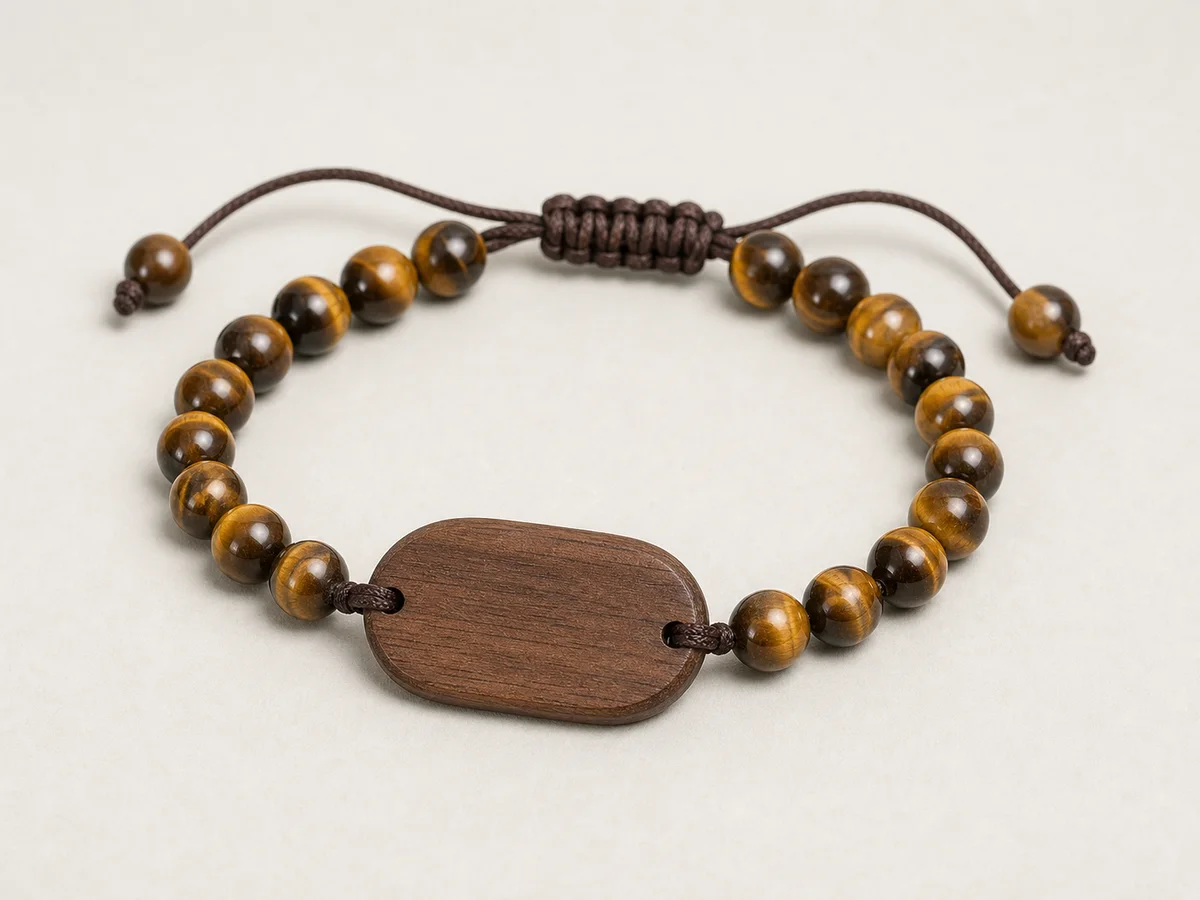
Tiger-eye’s fibrous structure produces chatoyancy: a bright band of reflected light that travels across the bead as the angle changes. On a wrist that means the band is never static — it catches light as the guest moves, which is why a simple string of neutral brown stones reads as considered rather than plain.
That effect depends on how the beads are cut relative to the fibre. Beads cut consistently show the band travelling in step along the string; beads cut randomly show it scattered, which looks like a cheaper product. Orientation is therefore specified and sampled rather than left to the batch.
Why it is the stone for sun-exposed use
It is quartz, so it is hard and non-porous like amethyst, but its colour comes from iron staining within the fibre structure rather than from a light-sensitive centre. In practice that means it holds its tone under sustained sun where amethyst pales.
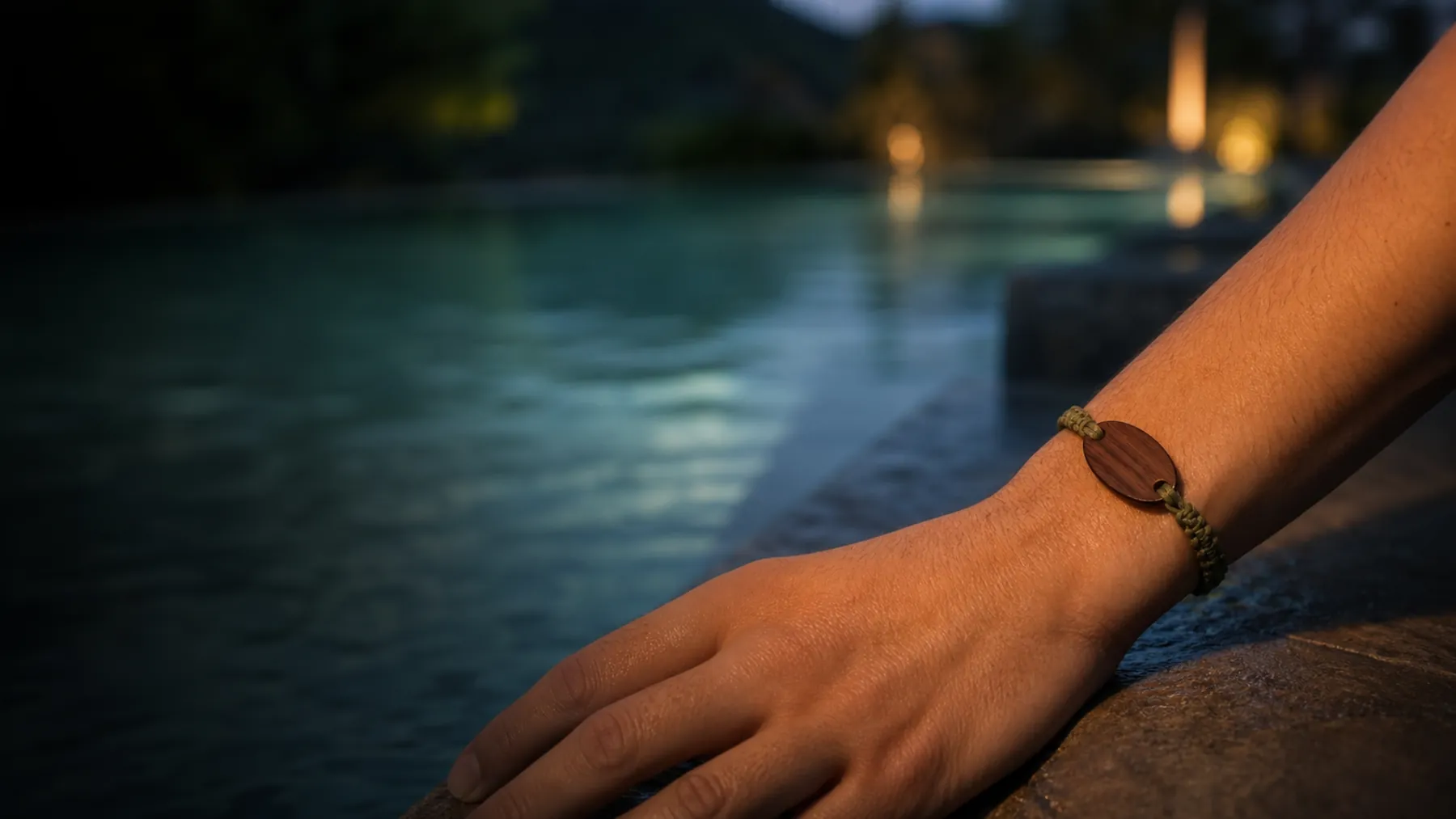
Combined with a non-porous surface that shrugs off sunscreen, that makes it the one stone construction we are comfortable specifying for a beach club or a pool terrace — with the standing caveat that the cord, not the stone, sets the limit in wet use.
Tiger-eye handles sun and sunscreen well. Repeated immersion still works water into the bead bores and onto the cord, so this remains a dry and splash construction rather than a swimming one.
A neutral that does not fight the property palette
Gold-brown sits comfortably against almost any interior or uniform palette, which matters when a property is issuing one credential across several venues with different design languages. A strongly coloured stone forces a palette decision; this one does not.
It also photographs well, which is a real consideration for a band guests will wear in their own photographs. Warm neutrals read as jewellery in a way that saturated colours read as event stock.
Variation, and how much to allow
Banding pattern and tone vary bead to bead and batch to batch. Some of that variation is the appeal; too much of it looks unsorted. We approve a range for tone and a standard for banding orientation, so the string reads as a set rather than as a collection.
Reordering against those two references — tone range and orientation standard — is what keeps a band issued next season looking like the band issued this one.
Wear, cleaning and reissue
The stones are effectively permanent in service and clean completely, so recovered bands can be reissued after inspection. As with every strung construction, the inspection is of the cord: relaxation, oil uptake and any movement at the knot.
Because this model is specified for sun-exposed programmes, the cord takes more UV than it would indoors. A cord retirement point should be set on time in service rather than on appearance alone, since UV degradation is not visible until it matters.
When this is the wrong model
It is wrong for swimming programmes, children and high-volume day issue, for the same reasons as every strung band: the cord, the sizing and the value.
It is also wrong where a property wants an obvious colour signal. This is a neutral by design, and a tiered access system that depends on colour recognition needs a moulded band instead.